At a glance
- Product
- Ranvier, MCAT prep built around the questions you miss. A short adaptive diagnostic finds why you miss them, and a daily path rebuilds around those gaps and leaps over what you already know.
- My role
- Product lead, covering who it is for, what the diagnostic measures, how the daily path is built and what the AI tutor is allowed to do.
- Timeframe
- Ongoing.
- Status
- A platform I designed and built, shown end to end with sample data.
OutcomeA design where every miss is sorted by its cause, the study path rebuilds itself around the weak spots, and a tutor explains from the passage.
- Every miss is sorted by its cause, so students with the same score get different fixes.
- Node, the tutor, is software and explains only from the passage, with every claim linked to its line.
- Every day on the path says why, in a sentence.
Reports at the end of the page are the independent quality findings and how the site was reviewed.
The problem and who has it
A fixed syllabus walks every student through every chapter. Ranvier finds what you already know and spends your time only where the points are. Two students with the same score can need opposite fixes, so Ranvier is built for the differences.
Two ways to prepare
Traditional prep
Every content category, in order, the same for everyone
With Ranvier
Only your weak points
Days to spend on what matters most.
Days back
What this student skips: the twelve categories already proved
- 1BGene to protein
- 2ACell assemblies
- 2CCell division
- 4AMotion, forces and energy
- 4BFluids and gas exchange
- 5BIntermolecular interactions
- 5CSeparation and purification
- 6ASensing the environment
- 6CResponding to the world
- 7CAttitude and behavior change
- 8ASelf identity
- 9ASocial structure
A sample for one student, not a result.
Notice. The same student on a traditional route, with every chapter in order, and on the Ranvier route, with only the blocks that were not already solid.
Signal Diagnostic
A short adaptive test instead of a full-length first exam. It tells you why you miss, not only what.
Leap
Prove you know a topic in a few questions and jump past it.
Tune your path
Set your hours, study style and session length. The path rebuilds around you.
Node sessions
A tutor that builds custom sessions, such as explain, coach, drill, debrief or teach-back.
Stamina training
See where your accuracy drops across a full-length exam, and train for it.
The context and the evidence
The MCAT has four sections, which are chemical and physical foundations, critical analysis and reasoning skills (CARS), biological and biochemical foundations, and psychological and social foundations. It is a very long exam, and most test takers prepare for months.
Nothing knows about the rest
A question bank, flashcards, CARS drills, practice exams and a spreadsheet to hold it together. None of them knows about the others, so planning becomes a second job.
A practice exam says what, not why
It tells you what you got wrong. It rarely tells you why, and the fix for a content gap is different from the fix for a misread question.
The help that matters is billed by the hour
The most useful help is someone who explains why an answer is wrong and what to do next. That usually means a tutor billed by the hour, which many students can’t afford.
Why you missed
Your failure pattern
- Misreadmost often
- Content gapoften
- Trap answersometimes
- Ran out of timerarely
Each miss, and what it was
Your failure patterns
Weaken the argument CARS · Reasoning Beyond the Text
Why did you miss it?
Content gapMisread Trap answerTimeChanged
Root cause
Trap answer. Choice A restates a point the author already grants, so it cannot weaken the argument. The step that failed is the link between the claim and its evidence.
- How often
- Trap answers: sometimes
- What to do next
- A coach session on weakening an argument, with new passages
Weaken the argument CARS · Reasoning Beyond the Text
Which finding would most weaken the author’s claim that public libraries should drop late fines?
- AMost patrons say they dislike paying late fines.You chose this
- BLibraries that dropped late fines saw fewer books come back on time, so fewer patrons could borrow them.Answer
- CLate fines bring in only a small part of a library’s yearly income.
- DSome libraries already offer a short grace period.
Competitive against noncompetitive Bio/Biochem · 1A Structure and function of proteins
Why did you miss it?
Content gapMisreadTrap answerTimeChanged
Root cause
Content gap. Km rises with a competitive inhibitor. A noncompetitive one lowers Vmax and leaves Km where it was. The two patterns were swapped, so this is a gap in the content, not in the reading.
- How often
- Content gaps: often
- What to do next
- A short lesson on the inhibition types, then new questions on 1A
Competitive against noncompetitive Bio/Biochem · 1A Structure and function of proteins
A noncompetitive inhibitor is added to an enzyme reaction. Compared with no inhibitor, what happens to the apparent Km and Vmax?
- AKm rises and Vmax does not changeYou chose this
- BKm does not change and Vmax fallsAnswer
- CKm falls and Vmax falls
- DKm and Vmax both stay the same
NOT and EXCEPT stems Every section · reading the stem
Why did you miss it?
Content gap MisreadTrap answerTimeChanged
Root cause
Misread. The stem asks for the one that is NOT a function. Choice B is true, so it is the wrong pick. Read the last line of the stem before the choices, and mark NOT.
- How often
- Misreads: most often
- What to do next
- Stem drills first: read the last line of the stem before the choices
NOT and EXCEPT stems Every section · reading the stem
All of the following are functions of the plasma membrane EXCEPT:
- Aselective transport of ions
- Bcell signaling at the surfaceYou chose this
- Cattachment to neighboring cells
- Dstorage of the cell’s genetic informationAnswer
Cell potential sign Chem/Phys · 4C Electrochemistry and circuits
Why did you miss it?
Content gapMisreadTrap answerTimeChanged
Root cause
Content gap. Oxidation happens at the anode, so electrons leave it and flow to the cathode. The direction was reversed, which is a gap in the content for this category.
- How often
- Content gaps: often
- What to do next
- A lesson on galvanic cells, then new questions on 4C
Cell potential sign Chem/Phys · 4C Electrochemistry and circuits
In a galvanic cell, electrons flow spontaneously from the:
- Acathode to the anodeYou chose this
- Banode to the cathodeAnswer
- Csalt bridge to the cathode
- Dcathode through the salt bridge
Notice. A question type leaves the list only after two right answers days apart.
Who it is for
Testing for the first time
Months of preparation ahead and no clear place to begin. You start with a short diagnostic, not a full day, and leave with a starting estimate, an honest range and a path to your target.
Retaking
You have a score and need a different one. The miss fingerprint separates what you don’t know from what you misread, so the path fixes the right problem.
Studying around a job or a course load
Set different hours for each day of the week and sessions of different lengths. Miss a day and the path rebuilds across the rest of the week, with no backlog.
Strong in the sciences, weaker in CARS
CARS has its own three reasoning skills on the weak-spot map, timed passages in the daily path, and Node explanations that work from the passage.
Watching the cost
The help that matters most is usually a tutor billed by the hour. Node is software, so there is nothing to book.
Fading late in the exam
The exam is a full day. After each full-length exam you see where your accuracy drops, and stamina blocks are added to your path.
Goals and how success is measured
Ranvier has three goals, and each one answers a problem above.
Spend the time where the points are. Find what a student already knows and skip it, so the hours go to the gaps.
Tell students what they miss and why they miss it. Two students with the same score can need opposite fixes.
Make one plan out of the tools that do not know about each other. A daily path that rebuilds when a setting changes or a day is missed.
Content categories
31 on the AAMC outline · a check is for one at a time
Bio/Biochem Categories · 4 leapt
- 1AProteins and enzymes
- 1BGene to proteinLeapt
- 1CHeritable informationLeapt
- 1DBioenergetics and metabolism
- 2ACell assembliesLeapt
- 2BProkaryotes and viruses
- 2CCell division
- 3ANervous systemLeapt
- 3BOrgan systems
Chem/Phys Categories · 4 leapt
- 4AMotion, forces and energyLeapt
- 4BFluids and gas exchange
- 4CElectrochemistry and circuits
- 4DLight and sound
- 4EAtoms and nuclear decayLeapt
- 5AWater and its solutions
- 5BIntermolecular interactions
- 5CSeparation and purification
- 5DBiological moleculesLeapt
- 5EThermodynamics and kinetics
Psych/Soc Categories · 4 leapt
- 6ASensing the environmentLeapt
- 6BMaking sense of it
- 6CResponding to the worldLeapt
- 7AIndividual influences
- 7BSocial processes
- 7CAttitude and behavior change
- 8ASelf identityLeapt
- 8BSocial thinking
- 8CSocial interactions
- 9ASocial structure
- 9BDemographicsLeapt
- 10ASocial inequality
Leapt, out of content reviewCheck not passed, review keptIn content review
5B Nature of molecules and intermolecular interactions
Leap is offered one category at a time, once your answers in it are strong and no miss there is open. CARS tests reading skills, not content, so its practice stays in your plan every day.
| What is measured | How it is checked | Where it stands |
|---|---|---|
| Where each student is, in every section | A short adaptive diagnostic gives three signals in each section, namely knowledge, reasoning and pace | Designed and shown with sample students |
| Why each question was missed | Every miss is sorted as a content gap, a misread, a trap answer, time or a changed answer | Designed and shown with sample students |
| Whether a topic can be skipped | A few questions prove a topic, and proven topics stay in the timed review | Designed and shown with sample students |
| Whether students improve | Score gain and accuracy | Not claimed. No score gain or accuracy is claimed anywhere on this page. |
My role and the decisions I made
I owned the product, including who it is for, what the diagnostic measures, how the daily path is built and what the AI tutor is allowed to do. Two decisions mattered most, which were to sort every miss by its cause and to fix in advance what Node may do.
What I owned
- The idea that a fixed syllabus is the wrong default, so study what you miss, skip what you know.
- The design of the Signal Diagnostic and the three signals it gives.
- The rules for Node as software, not a person, explaining from the passage, with an expert review gate before any change to its explanations.
- What Ranvier includes and what the student brings, with the official practice exams staying the student’s own.
- What the page does not claim.
Weaken the argument
3I have stood in front of the same small portrait in three cities, and each time it taught me something the plates in my books never had. The painting did not change. The light did, and so did the people beside me. An object teaches most where people can stand in front of it, and most people will never travel to where it lives.
4Curators answer that travel is a risk, and they are right. Crates are dropped, humidity drifts, and a crack in a panel cannot be undone. I do not wave this away. But a museum that never lends has decided that the object matters more than anyone who might learn from it.
Which finding, if true, would most weaken the author’s argument for lending?
- AMost damage to lent works happens in transit, not in the host museum.
- BVisitors learned as much from a high quality reproduction as from the original.
- CMuseums that lend widely draw more visitors to their own galleries.
- DNo lent work has ever been damaged beyond repair.
- N
Before the choices. What reason does the author give for lending? Highlight it.
highlighted ¶3An object teaches most where people can stand in front of it.
- N
That is the premise. Now ¶4. Does the risk of travel hurt the argument?
Yes. If works get damaged, lending is a bad idea. So A.
- N
Read the first line of ¶4 again. The author says the curators are right. A cost the author already grants cannot weaken the argument. Which choice attacks your highlight?
B. If a copy teaches as well, standing in front of the original is not what matters.
- N
Yes. That is the trap you fell for on Monday. Next, three new passages, same question type.
Notice. Node starts from the student’s own misses, and a lesson folds away the parts the student already proved.
Decisions
Study what you miss, skip what you know
A fixed syllabus walks every student through every chapter. Ranvier finds what you know and spends your time where the points are. Prove a topic in a few questions and the path skips it, and leapt topics stay in your timed review so you keep them.
A short adaptive diagnostic, not a full-length first exam
A short adaptive test in place of a full-length first exam. It adapts question by question and stops when it is confident, and it gives three signals in every section, namely knowledge, reasoning and pace.
Sort every miss by its cause
Two students with the same score can need opposite fixes. Every miss is sorted as a content gap, a misread, a trap answer, time or a changed answer, so the path fixes the right problem.
Every day says why
The path explains its choice in a sentence, such as that CARS comes next because it has the most points available for you this week.
No backlog
Miss a day and the path rebuilds across the rest of the week. Full-length exams stay where you scheduled them.
Explain from the passage
Node shows why each choice is right or wrong, points to the line in the passage and names the content category or CARS skill it tests. It is a study aid, not a person.
Original practice content, official exams stay yours
All practice content is original, written for Ranvier. Ranvier is built to replace the planner, the flashcard deck and the hourly tutor. It does not replace the official practice exams. You bring them and log your scores.
Practice on a screen that feels like test day
Test day mode is laid out like the real exam, with section timing and breaks that match it, and it is not an AAMC product.
How it was made
Ranvier was made in the order below. Each step names what it produced, and only steps the product’s own notes support are listed.
- 1DiscoverThe usual route through MCAT prep is a question bank, flashcards, CARS drills and practice exams that do not know about each other, and help that is billed by the hour.
- 2RequirementsSort every miss by cause, explain from the passage, and say why every day on the path is what it is.
- 3PrioritizeA short adaptive diagnostic instead of a full-length first exam, so the first day is spent studying.
- 4DesignThe diagnostic, the path with Leap, Node sessions, test day mode, review, and the weak-spot map.
- 5BuildThe website shows the whole platform with sample students; the screens and scenes are sample data, not results.
- 6CheckAn independent quality agent checked the site and kept a findings log, and a review panel of simulated personas looked at it.
- 7Next stageStudent outcomes are not claimed. The step beyond sample students is a product with users.
The solution, step by step
1. The Signal Diagnostic
Diagnose
A short run of adaptive questions finds your level in every section and give three signals for each, namely knowledge, reasoning and pace. You get a starting estimate with a likely range.
Set the target and the hours
Your target score, your test date and the hours you have on each day of the week. Then how you like to study, whether questions first or review first, short sessions or long ones, weakest areas first or a balanced mix.
Open today's path
Each day lists its tasks and the time each takes, including review cards that are due, timed passages in your weakest section, questions on a weak content category and a Node session.
Leap what you know
Prove a topic in a few questions and the path skips it. Leapt topics stay in your timed review, so you keep them.
Sit the full-length exams
They stay on the days you scheduled. Afterwards Node walks through your most costly misses in order, and the stamina curve shows where your accuracy dropped.
The path rebuilds
The miss fingerprint updates after every session and every full-length exam. The next week is built around the gaps that matter most for your target.
Passage
Many enzymes are slowed by small molecules that look like their substrate. A research group studied one such enzyme, which turns a single substrate into a single product in a well mixed buffer at a constant temperature. To learn how a small molecule, here called compound X, changes the enzyme, they measured the starting rate of the reaction at many substrate concentrations, first with the enzyme alone and then with a fixed amount of compound X added. Every rate was taken within the first minute, before the substrate was used up.
Each measurement was repeated three times and the three values were averaged. The group plotted the average rate against substrate concentration and fitted the curves to the standard saturation equation. Figure 1 shows both curves.
With compound X present, more substrate was needed to reach half of the top rate, but the top rate itself did not change. Adding a large excess of substrate removed the effect of compound X completely.
The group then repeated the measurements after warming the mixture slightly. Both curves rose faster at low substrate concentration, and the difference between them stayed the same. When the mixture was warmed much further, the rate fell sharply with or without compound X, and it did not recover when the mixture was cooled again.
To see where compound X acts, the group changed one amino acid in the active site, the pocket that normally holds the substrate in place. The altered enzyme turned over substrate much more slowly, and compound X now had almost no effect on it. A second altered enzyme, changed at a site far from the active site, still responded to compound X as before.
In a last series, the group doubled the amount of compound X and again measured the starting rate at many substrate concentrations. The substrate concentration needed to reach half of the top rate rose by about the same factor as the amount of compound X, while the top rate stayed where it had been in the first series.
A control mixture held the enzyme and compound X without substrate for the same minute. No product appeared, so compound X was not being converted by the enzyme, and the small amount of product seen in every other mixture could be credited to the substrate.
The group concluded that compound X and the substrate compete for the same site, and noted two limits. The measurements were made at a single acidity, and they used a purified enzyme, not the enzyme inside living cells, where many other molecules are present.
Based on the passage and Figure 1, which of the following best describes the effect of compound X on Km and Vmax?
- AKm rises and Vmax does not change
- BKm falls and Vmax does not change
- CKm does not change and Vmax falls
- DKm rises and Vmax falls
How sure are you?
What was your reasoning? Choose all that apply
In your own words, why? Optional
Question 2 of 5. The group doubled the amount of compound X. Based on the passage, which result would be expected at the same substrate concentrations?
- AThe top rate falls by about half
- BThe substrate concentration needed for half of the top rate rises, and the top rate is unchanged
- CThe substrate concentration needed for half of the top rate falls, and the top rate rises
- DThe enzyme converts compound X into a second product
Most prep starts with a full-length exam that takes a day and returns a few numbers. The Signal Diagnostic adapts to you question by question and stops when it is confident. It measures three things in every section, namely what you know, how you reason and your pace. Each answer picks the next question, harder when you’re right and easier when you’re not.
The design is for a short run of questions that finds your level in every section, so you spend the day studying, not sitting a test. In the scene below two students answer the same share correctly and end at different levels.
Each question also gives a signal that is not right or wrong, namely how the student reads it, what they strike out and when they pass the pace mark. The range then narrows as more of the exam has been taken.
2. Why you miss
A score says what happened and not why. Every miss is sorted into a cause, and together the causes form a miss fingerprint that the rest of the product uses.
Chem/Phys
59 questions · 95 min
- 4A✓4A Motion, forces and energy, Solid
- 4B✓4B Fluids and gas exchange, Solid
- 4C!4C Electrochemistry and circuits, Gap
- 4D4D Light and sound, Not measured yet
- 4E4E Atoms and nuclear decay, Not measured yet
- 5A~5A Water and its solutions, Building
- 5B✓5B Intermolecular interactions, Solid
- 5C✓5C Separation and purification, Solid
- 5D~5D Biological molecules, Building
- 5E~5E Thermodynamics and kinetics, Building
Chemical and Physical Foundations of Biological Systems
59 questions · 95 min
Foundational concept 4
Complex living organisms transport materials, sense their environment, process signals, and respond to changes using processes understood in terms of physical principles.
- 4ASolidMotion, forces and energyTranslational motion, forces, work, energy, and equilibrium in living systems
- 4BSolidFluids and gas exchangeImportance of fluids for the circulation of blood, gas movement, and gas exchange
- 4CGapElectrochemistry and circuitsElectrochemistry and electrical circuits and their elements
- 4DNot measured yetLight and soundHow light and sound interact with matter
- 4ENot measured yetAtoms and nuclear decayAtoms, nuclear decay, electronic structure, and atomic chemical behavior
Foundational concept 5
The principles that govern chemical interactions and reactions form the basis for a broader understanding of the molecular dynamics of living systems.
- 5ABuildingWater and its solutionsUnique nature of water and its solutions
- 5BSolidIntermolecular interactionsNature of molecules and intermolecular interactions
- 5CSolidSeparation and purificationSeparation and purification methods
- 5DBuildingBiological moleculesStructure, function, and reactivity of biologically relevant molecules
- 5EBuildingThermodynamics and kineticsPrinciples of chemical thermodynamics and kinetics
CARS
53 questions · 90 min
- Foundations of Comprehension~FC Foundations of Comprehension, Building
- Reasoning Within the Text~RW Reasoning Within the Text, Building
- Reasoning Beyond the Text!RB Reasoning Beyond the Text, Gap
Critical Analysis and Reasoning Skills
53 questions · 90 min
The three skills
- FCBuildingFoundations of ComprehensionUnderstanding the basic components of the text; inferring meaning or intent from immediate sentence context
- RWBuildingReasoning Within the TextIntegrating distant components of the text; recognizing and evaluating arguments and their structural elements
- RBGapReasoning Beyond the TextApplying or extrapolating ideas from the passage to new contexts; assessing the impact of new factors, information or conditions
Bio/Biochem
59 questions · 95 min
- 1A!1A Proteins and enzymes, Gap
- 1B✓1B Gene to protein, Solid
- 1C1C Heritable information, Not measured yet
- 1D~1D Bioenergetics and metabolism, Building
- 2A✓2A Cell assemblies, Solid
- 2B2B Prokaryotes and viruses, Not measured yet
- 2C✓2C Cell division, Solid
- 3A~3A Nervous system, Building
- 3B~3B Organ systems, Building
Biological and Biochemical Foundations of Living Systems
59 questions · 95 min
Foundational concept 1
Biomolecules have unique properties that determine how they contribute to the structure and function of cells and how they participate in the processes necessary to maintain life.
- 1AGapProteins and enzymesStructure and function of proteins and their constituent amino acids
- 1BSolidGene to proteinTransmission of genetic information from the gene to the protein
- 1CNot measured yetHeritable informationTransmission of heritable information from generation to generation and the processes that increase genetic diversity
- 1DBuildingBioenergetics and metabolismPrinciples of bioenergetics and fuel molecule metabolism
Foundational concept 2
Highly organized assemblies of molecules, cells, and organs interact to carry out the functions of living organisms.
- 2ASolidCell assembliesAssemblies of molecules, cells, and groups of cells within single cellular and multicellular organisms
- 2BNot measured yetProkaryotes and virusesThe structure, growth, physiology, and genetics of prokaryotes and viruses
- 2CSolidCell divisionProcesses of cell division, differentiation, and specialization
Foundational concept 3
Complex systems of tissues and organs sense the internal and external environments of multicellular organisms, and through integrated functioning, maintain a stable internal environment within an ever-changing external environment.
- 3ABuildingNervous systemStructure and functions of the nervous and endocrine systems and ways these systems coordinate the organ systems
- 3BBuildingOrgan systemsStructure and integrative functions of the main organ systems
Psych/Soc
59 questions · 95 min
- 6A✓6A Sensing the environment, Solid
- 6B~6B Making sense of it, Building
- 6C✓6C Responding to the world, Solid
- 7A~7A Individual influences, Building
- 7B~7B Social processes, Building
- 7C✓7C Attitude and behavior change, Solid
- 8A✓8A Self identity, Solid
- 8B~8B Social thinking, Building
- 8C8C Social interactions, Not measured yet
- 9A✓9A Social structure, Solid
- 9B9B Demographics, Not measured yet
- 10A~10A Social inequality, Building
Psychological, Social, and Biological Foundations of Behavior
59 questions · 95 min
Foundational concept 6
Biological, psychological, and sociocultural factors influence the ways that individuals perceive, think about, and react to the world.
- 6ASolidSensing the environmentSensing the environment
- 6BBuildingMaking sense of itMaking sense of the environment
- 6CSolidResponding to the worldResponding to the world
Foundational concept 7
Biological, psychological, and sociocultural factors influence behavior and behavior change.
- 7ABuildingIndividual influencesIndividual influences on behavior
- 7BBuildingSocial processesSocial processes that influence human behavior
- 7CSolidAttitude and behavior changeAttitude and behavior change
Foundational concept 8
Psychological, sociocultural, and biological factors influence the way we think about ourselves and others, as well as how we interact with others.
- 8ASolidSelf identitySelf-identity
- 8BBuildingSocial thinkingSocial thinking
- 8CNot measured yetSocial interactionsSocial interactions
Foundational concept 9
Cultural and social differences influence well-being.
- 9ASolidSocial structureUnderstanding social structure
- 9BNot measured yetDemographicsDemographic characteristics and processes
Foundational concept 10
Social stratification and access to resources influence well-being.
- 10ABuildingSocial inequalitySocial inequality
Biological and Biochemical Foundations of Living Systems
Every foundational concept and content category of the section, as the AAMC outline lists them
Foundational concept 1
Biomolecules have unique properties that determine how they contribute to the structure and function of cells and how they participate in the processes necessary to maintain life.
- 1AProteins and enzymesStructure and function of proteins and their constituent amino acidsGap
- 1BGene to proteinTransmission of genetic information from the gene to the proteinSolid
- 1CHeritable informationTransmission of heritable information from generation to generation and the processes that increase genetic diversityNot measured yet
- 1DBioenergetics and metabolismPrinciples of bioenergetics and fuel molecule metabolismBuilding
Foundational concept 2
Highly organized assemblies of molecules, cells, and organs interact to carry out the functions of living organisms.
- 2ACell assembliesAssemblies of molecules, cells, and groups of cells within single cellular and multicellular organismsSolid
- 2BProkaryotes and virusesThe structure, growth, physiology, and genetics of prokaryotes and virusesNot measured yet
- 2CCell divisionProcesses of cell division, differentiation, and specializationSolid
Foundational concept 3
Complex systems of tissues and organs sense the internal and external environments of multicellular organisms, and through integrated functioning, maintain a stable internal environment within an ever-changing external environment.
- 3ANervous systemStructure and functions of the nervous and endocrine systems and ways these systems coordinate the organ systemsBuilding
- 3BOrgan systemsStructure and integrative functions of the main organ systemsBuilding
- !Gap
- ~Building
- ✓Solid
- Not measured yet
- Hover, focus or tap a section for its breakdown. Not an AAMC product.
Notice. The map shows which categories are solid and skipped, and which gaps are worth the most points.
3. A path that rebuilds itself
Set your target score, your test date and the hours you have. Then tune how you like to learn, whether questions first or review first, short sessions or long ones, weakest areas first or a balanced mix. Change any setting and the whole path rebuilds. Tell Ranvier your hours for each day, and if you miss one the path rebuilds across the rest of the week.
Practice follows the day
An optimized practice schedule aimed at your target score on test day.
- ✓A practice schedule that adapts to you
- ✓Q&A with Node, your coach, who explains from the passage
- ✓Mock practice exams at different times of day and timings
- ✓Four sections, in order: Chem/Phys, CARS, Bio/Biochem, Psych/Soc
- ✓59, 53, 59 and 59 questions in 1 h 35, 1 h 30, 1 h 35 and 1 h 35
- ✓Breaks of 10, 30 and 10 min, about 7 h 30 from check-in
The same path holds for exam-day accommodations. Practice follows the timing the student will have on the day.
4. Node, grounded in the passage
Node explains from the passage, with every claim linked to its line. It builds custom sessions for the cause of your misses, such as explain, coach, drill, debrief or teach-back. It answers from the passage and the content category the question tests, and shows the line behind each claim. Node is software, not a person, and an expert review gate comes before any change to its explanations.
Test day mode is a practice screen laid out like the real exam, with the same tools, namely highlight, strikethrough and flag for review. In the sample run below, one question of a sample section is worked on a sample passage. The result appears only after the section is ended, and then Node explains the answer. The numbers in it are sample data.
A sample run through question 1 of a Bio/Biochem section on the test day screen. After reading the passage, the student highlights the sentence in paragraph 3 that says Km did not change while kcat fell as the pH was lowered, strikes out choices B and D, picks choice C, flags the question and moves to question 2. Nothing on the screen says whether the answer was right. After the rest of the section, the review screen lists all seven questions as completed, question 1 marked.
Sample run on a sample passage written for Ranvier. No feedback until the section ends, as on test day. Laid out like the real exam, not an AAMC product.
What a student shares is up to them. A progress report can go to a parent or an advisor, and the Node conversations stay private.
5. How the parts fit together, and where the AI is
Review, practice and where the points are
- Content review, tailored. A traditional course makes you sit through every chapter. Open a topic in Ranvier and the parts you proved you know are already folded away. What is left is the idea you are missing, shown plainly, then questions to make it stick. Every AAMC content category is written for Ranvier, and every lesson ends in questions.
- The questions you miss most. A question bank hands everyone the same thousands of questions. Ranvier keeps a running list of the kinds of question you miss, tracked by question type and by cause, and serves those again, spaced out, until you get each right twice in a row. Cleared types stay in your review.
- Practice exams, scheduled for you. You bring the official AAMC practice exams. Ranvier places them where you have the time, spaces them for your test date, and adjusts the count and the plan after every score. The projection is a range, never one number.
- The weak-spot map. The map follows the official AAMC content outline, so you can see which categories cost you points and how much each is worth, with the three CARS skills alongside. Weak spots are ranked by the points you could gain, and the next week is built around the gaps that matter most for your target.
- The stamina curve. Many students lose points late in the day that they would have earned in the morning. After each full-length exam, Ranvier shows accuracy section by section and where your pace slips, then adds stamina blocks to your path.
What Ranvier includes, and what you bring
| Part of your prep | From | Detail |
|---|---|---|
| Practice passages and questions | Ranvier | Original content written for Ranvier, for the science sections and for CARS. |
| Review cards | Ranvier | Timed review, including the topics you leapt. |
| Study plan | Ranvier | Built around your target score, your test date and your hours, and rebuilt when any of them change. |
| Tutoring | Ranvier | Node, in five modes, which are explain, coach, drill, debrief and teach-back. |
| Official practice exams | You | You bring the official AAMC practice exams and sit them on the days you schedule. |
| Scores from other tools | You | Log your scores from the AAMC exams and from any question bank you already use, so your path accounts for everything. |
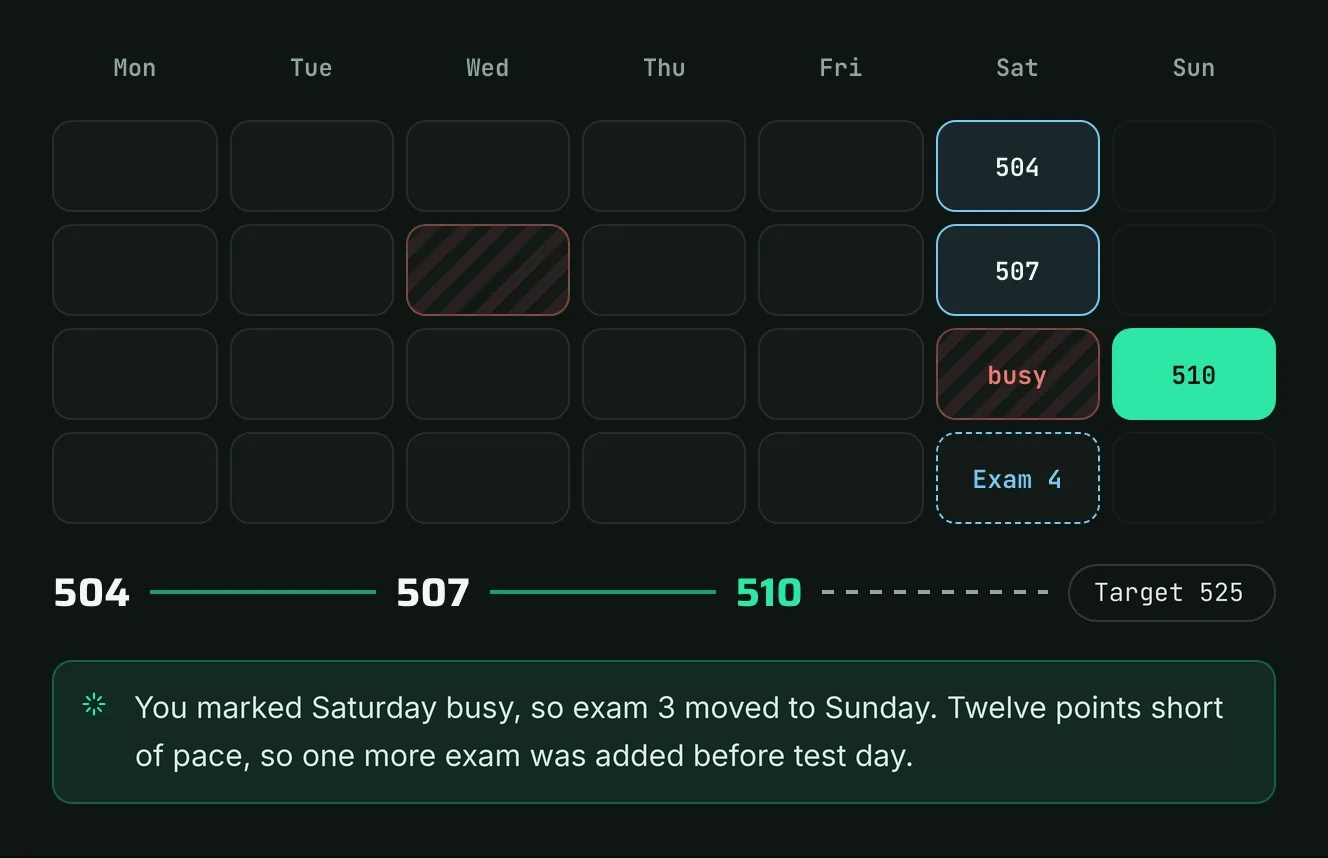
Notice. Marking a day busy moves an exam, and a short projection adds one.
The Signal Diagnostic produces the miss fingerprint and the weak-spot map. The daily path is built from them, your target score, your test date and your hours, and it rebuilds when you change a setting or miss a day. Node builds its sessions from the same fingerprint and map, in the mode you choose, and debriefs every practice exam, costliest misses first. Test day mode is the practice screen for the exam itself. As the evidence comes in, your projected range narrows.
Notice. The same score can come from different causes, which is why two students with the same score are given different fixes.
The screens and scenes on this page show sample student data, not results. MCAT® is a registered trademark of the AAMC. Ranvier is not affiliated with or endorsed by the AAMC.
Most of Ranvier is software that builds a plan from your answers. The AI is Node, the tutor, and what it is allowed to do is fixed in advance.
Week 11 · Mon 16 to Sun 22 Aug
-
Mon 162 h
- Review cards20
- CARS, passages35
- 4C questions45
- NOT and EXCEPT drill20
-
Tue 17missed
- Review cards30
- CARS passage30
- 7A questions30
- Node drill30
-
Wed 182 h 30
- Review cards25
- 1A Km and Vmax20
- Inhibition questions50
- Node coach, CARS25
-
Thu 192 h 30
- Review cards20
- CARS, passages35
- 5A questions40
- NOT drill25
-
Fri 202 h 30
- Review cards20
- CARS, passages35
- 4C questions40
- Light review25
-
Sat 217 h 30
- AAMC FL3
- Log your scores5
-
Sun 223 h
- FL3 review with Node
- Costliest misses first
plannedmoved from Tuesdayhours you set
| Job | What it does | The rule it works under |
|---|---|---|
| Node, the tutor | Builds a session from your weak spots in the style you ask for, such as explain, coach, drill, debrief or teach-back | Node is software, not a person. It explains from the passage, with every claim linked to its line. Experts review a sample of its explanations before any change. |
| The diagnostic, the path and the weak-spot map | Built from your answers, your target score, your test date and your hours | Every day says why, in a sentence, and changing any setting rebuilds the whole path. |
Questions students ask
Is Node a person?
No. Node is Ranvier’s built-in AI tutor. It is software, and there is nothing to book.
Does it replace my question bank?
Ranvier includes its own practice passages, review cards and study plan. If you already use a question bank, keep it if you like. Log your scores from it and your path takes them into account.
Do I still need the AAMC practice exams?
Yes. You bring the official AAMC practice exams, sit them on the days you schedule and log your scores, and your path takes them into account.
What if I miss a day?
The path rebuilds across the rest of the week. There is no backlog, and your full-length exams stay where you scheduled them.
Can I turn features off?
Yes. Leap, stamina blocks and weekend full-length exams can each be switched on or off.
Stamina in your plan
The longest stretch, week by week stamina only
- W2One timed section
- W4Half length 1, Sat 3 Jul, C/P then CARS
- W7Half length 2, Sat 24 Jul, B/B then P/S
- W9AAMC FL1, Sat 7 Aug, the whole day
- W10AAMC FL2, Sat 14 Aug, the whole day
- W11AAMC FL3, Sat 21 Aug, review Sunday7 h 30
- W12Half length 3, Sun 29 Aug, CARS then Psych/Soc last
- W13AAMC FL4, Sat 4 Sep7 h 30
- W14Test day, Sat 11 Sep. Rest on Fri 10 Sep
What the plan keeps
- Content review first, full lengths after
- A review day after each full length
When a day moves
- Half length 3 moved from Sat 28 Aug, marked busy, to Sun 29 Aug
Results, what I learned and what is next
This section says what was built and where it stops. The screens and scenes on this page show sample student data, and it reports no numbers.
| What | What it does | Where it stops |
|---|---|---|
| The platform | Built end to end, covering the Signal Diagnostic, the study path with Leap, Node sessions, the weak-spot map and stamina training | A platform I designed and built, shown with sample students. |
| Student outcomes | Not claimed | No score gain or accuracy is claimed anywhere on this page. |
What I learned
- Two students with the same score can need opposite fixes, so the cause of a miss is the thing to design around.
- Saying why each day is what it is makes a rebuilt plan easier to trust.
- A design shown with sample students is easy to mistake for a product with users, so the page says plainly which one it is.
What I would do next
- Put the platform in front of real students, so the page can speak about outcomes. Today none is claimed.
- Keep the expert review gate in front of every change to Node’s explanations.
- Keep the official practice exams the student’s own and keep logging scores from them.
Reports
Each report below says what it covers and what it does not.
- The independent quality findings. What an independent check found in the content and how it was fixed.
- How the site was reviewed. The verification and the simulated review rounds.
The independent quality findings
An independent quality agent checked the site and kept a findings log, one block per finding. The content findings were of one kind. A sample question’s explanation did not name the answer the key marked, so a reader could not tell which choice was meant. Each was fixed by opening the explanation with the keyed choice, and the fix was confirmed on the next build. A further finding was that the test day page did not state the exam structure it follows; it now does, and the check requires it from now on. The static passes found every link, image and anchor resolving, the copy rules clean, and the sample student agreeing on every page that repeats it.
It covers the website’s content and wording. It does not measure learning, and the sample data stays sample data.
How the site was reviewed
Every change to the site goes through one verification step. It regenerates the drawings, builds the site, runs the copy linter and the functional tests, and checks the layout across widths. Separately, a review panel of simulated personas looks at the site as a designer, an end user and a prospective buyer, and each round is recorded. The write-up says plainly that the reviewers are simulated personas, not real people.
It covers how the site was checked and reviewed. It says nothing about how real students would do.