At a glance
- Product
- Aurifex Healthcare, the company I co-founded. It predicts each patient’s expected discharge date, flags likely inpatient rehab candidates in the case-management worklist and drafts the referral for a person to approve, built to run inside Epic.
- My role
- Chief Product Officer and Co-Founder, AI/ML, covering product vision, model and agent design, evaluation and safety design, from concept to working product.
- Timeframe
- 2025 to present.
- Status
- Live. Built to run inside Epic and evaluated on 25,000 held-out historical admissions.
OutcomeA discharge-planning product where the date, the rehab flag and the drafted referral all show their sources, and a person approves every step.
- Agents draft and people decide, and nothing leaves without a person.
- Every line of a draft shows the note it came from.
- It is designed to live in the Epic worklist the team already opens every morning.
Reports at the end of the page are the evaluation report and the safety and monitoring note.
The problem and who has it
I co-founded Aurifex Healthcare and lead product as Chief Product Officer. Aurifex Healthcare predicts each patient’s expected discharge date, flags likely candidates for acute inpatient rehab (IRF) in the case-management worklist, and drafts the referral packet and the PM&R consult request for clinicians to approve. It’s built to run inside Epic and pairs a gradient-boosted model with GPT-4o agents.
Case managers
They plan every discharge on the unit and write the referrals. A good rehab referral means reading days of notes for evidence that the patient can handle intensive therapy, which took about 45 minutes per referral in workflow testing.
Physicians and nurses
They decide when a patient is medically ready, but the discharge plan often starts after that point instead of before it. They need the expected date early enough to act on it.
Hospital operations
They carry the cost of every day a patient stays past need, and they need a view of the whole unit, not one patient at a time.
I chose discharge and placement over the many other places AI could help a hospital because the cost of delay is concrete, the people who fix it are a small, identifiable group, and the work that slows them down, reading notes and writing referrals, is what language models do well when someone checks their work. It also has an outcome a hospital already measures, length of stay and excess days, adjusted for how sick the patients were.
The patient is ready. The plan is not.
The bed stays full while the referral, the authorization and the equipment catch up. Hospitals have bought dashboards, command centers and referral networks that show the logjam. They do not clear it, because the work in the middle is still done by hand, one chart at a time.
Compared with how hospitals do it today
Hospitals already plan discharges, so the honest comparison is with the ways they do it now.
| The usual way | What it does well | Where it falls short for this job | What this does differently |
|---|---|---|---|
| Case managers by hand | Knows the patient and the family; flexible | Reads days of notes to find rehab candidates and rewrites a referral for each facility; the date is the clinician’s estimate | Reads the notes first, flags likely candidates with the source for each line, and drafts the packet for the case manager to approve |
| Rules and scores in the record | Built in; no new system | Fixed rules miss what is only in free-text notes | Reads the notes as well as structured data and is refit on each hospital’s own history |
| Capacity and bed-flow tools | See the whole hospital at once | Work at the level of beds and units, not the next place of care or the referral | Works at the patient level, from expected date to drafted referral, and feeds unit views |
| Referral networks and post-acute platforms | Reach many facilities | Start after the decision; do not predict who needs a referral or draft it | Sits before the network, deciding who to look at and preparing what the network needs |
This compares kinds of tools, not named products, and quotes no figures. Only what is true of the whole kind is claimed. Sourced figures for named alternatives will be added when each can be checked at its source.
Goals and how success is measured
The goal is a discharge plan that starts early and stays honest. Every patient gets an expected date from the second day, the patients who may need inpatient rehab are found without reading days of notes, and a referral is drafted so that a person only has to check it. Success is judged against the unit’s own baseline, with a safety check beside every outcome.
How success is measured
Outcomes
Length of stay, excess days and IRF acceptance, each against the unit’s own baseline and adjusted for case mix.
Safety
Readmissions and emergency returns as balancing measures, so a shorter stay can’t hide a worse outcome.
Real-world accuracy
Flag precision on the unit’s own patient mix, and how the worklist is used on a busy morning.
My role and the decisions I made
I co-founded Aurifex Healthcare and lead product. I owned the product vision, the model and agent design, evaluation, pricing and go-to-market, from concept to working product. The decisions below are the ones I would defend first.
Agents draft, people decide
Agents review each admission, flag possible IRF candidates and draft the referral packet and the PM&R consult request. A case manager approves, edits or rejects every referral before it’s sent, and the attending signs the consult.
Trade-off: slower than sending automatically, and every draft needs a person’s time. I took that trade because one wrong referral sent in a clinician’s name would cost more trust than the minutes it saved.
Not chosen: auto-sending referrals that pass the automated checks.
Build inside Epic, not beside it
Flags, dates and drafts are built to appear in the Epic worklist case managers already open every morning, so using Aurifex Healthcare is part of the job rather than one more login.
Trade-off: slower integration and a dependence on each hospital’s Epic analysts. The gain is nothing new to learn on a busy unit.
Ruled out: a separate dashboard, which would have been faster to build and easier to ignore.
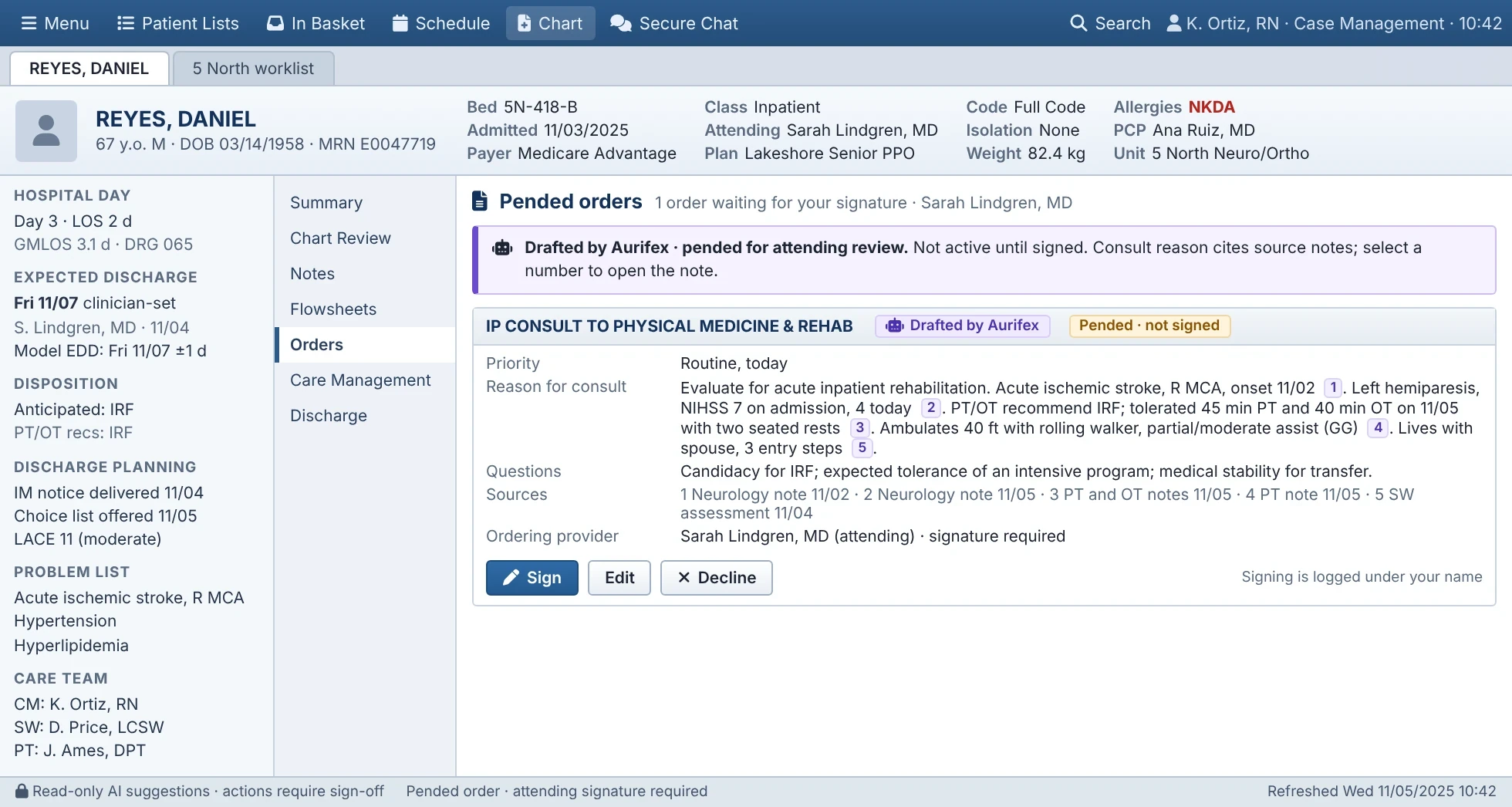
- 1 The order is pended. It is not active until signed.
- 2 The reason for consult cites its source notes.
- 3 Sign, edit or decline. Signing is logged under your name.
Three smaller calls
- Solve one decision. The whole product aims at where a patient goes next and when, which gives Aurifex Healthcare one buyer, one outcome and one group of users to win over. Passed on: a general assistant for the whole care team.
- The right model for each job. A gradient-boosted model predicts the discharge date from structured data, where it can be checked against the real date; GPT-4o agents handle the free-text notes. Instead of: one language model for everything, including the date.
- A source for every sentence. Every statement in a summary or draft must cite the note it came from. Rejected: free-form summaries, which are faster to generate and slower to check.
How it was made
The product was made in the order below. Each step names what it produced, from the page’s own notes.
- 1DiscoverWhat hospitals use today (dashboards, command centers, case managers reading notes) and where each falls short for this one job.
- 2RequirementsOne decision, where a patient goes next and when. A person approves every step, and every draft line shows its source.
- 3PrioritizeInpatient rehab referrals first, because they are evidence-heavy and well defined. Skilled nursing and home health come later.
- 4DesignAgents draft and people decide, inside Epic and not beside it, with a worklist, a candidacy review, a referral packet and a unit board.
- 5BuildA gradient-boosted model for the date and language-model agents for the reading and drafting, built with Claude Code behind an evaluation gate.
- 6CheckAn evaluation set of held-out historical admissions, expert-labeled cases and simulated referral work, plus gates before a model or prompt reaches clinicians.
- 7Roll outA planned pilot that connects, tests on history, runs in silent mode, then has a supervised start with weekly review.
Build and evaluate
Aurifex Healthcare went from concept to a working product in about 6 months, with 300+ changes merged behind the evaluation gate. It’s built with Claude Code, and every change goes through a GitHub pull request with automated tests and the evaluation gate. For go-to-market I also built the company website.
A hospital rollout is designed to run about 20 weeks on one or two units.
- 1ConnectEpic FHIR access and the ADT feed
- 2Test on historyThe date model is checked on the hospital's own past discharges
- 3Silent modePredictions and drafts run on live data, unseen, and are compared with what happened
- 4Go-liveOn one or two units, once the launch gates are met and the hospital signs off
- 5Weekly reviewSampled drafts, flags and misses, reviewed with the hospital
The solution, step by step
1. Six roles, one discharge plan
Six roles, one discharge plan
Case managers
They plan every discharge on the unit and write the referrals. They review Possible IRF flags, edit and send the inpatient rehab referral, and work the barriers they own. Caseload assignments don’t change.
Physicians and PM&R
They decide when a patient is medically ready and whether rehab is right. The PM&R consult arrives drafted as a pended order. The attending reviews, edits and signs it, or declines.
Nursing and unit leaders
The charge nurse runs the huddle from one unit view that shows who is expected out today and tomorrow, who is past their expected date, and every open barrier with its owner.
Social workers
They keep skilled nursing placement, payer and psychosocial work, and use the anticipated next place of care to start earlier.
Operations and finance
They carry the cost of every day a patient stays past need. They see length of stay and excess days by unit, measured against each unit’s own baseline and adjusted for case mix.
IT and clinical informatics
Standard interfaces, single sign-on through the hospital’s identity provider, role-based access, and an audit trail of every read, draft, edit, approval and rejection.
A case manager's day
| Time | Step | What happens |
|---|---|---|
| 7:30 | Huddle | The unit view lists who is expected out today and tomorrow, who is past their expected date and every open barrier with its owner. |
| 9:00 | Worklist | The model’s expected date sits beside the clinician’s for each patient. New Possible IRF flags are at the top, each with a cited summary. |
| 11:00 | Review and send | Open a drafted referral, check the sources, edit what needs it, confirm the patient’s choices and send it. Most days that is one to three drafted referrals. |
| 2:00 | Authorizations and barriers | Medicare Advantage and commercial authorizations show as barriers with their age. Bed offers and equipment deliveries are followed up from the same list. |
| 4:00 | Tomorrow’s plan | Expected discharges for tomorrow are confirmed, and anything still open has an owner and a next step. |
A typical day for a case manager on a unit using Aurifex Healthcare. Huddle times and steps stay the hospital’s own. Flags raised overnight or on a weekend wait in the worklist for the next case-management shift.
The case manager’s day starts in the worklist. Aurifex Healthcare adds its expected discharge date beside the clinician-set date, which it never overwrites, plus the likely next place of care and a flag on possible IRF candidates, so the morning huddle starts with the patients who need a plan today.
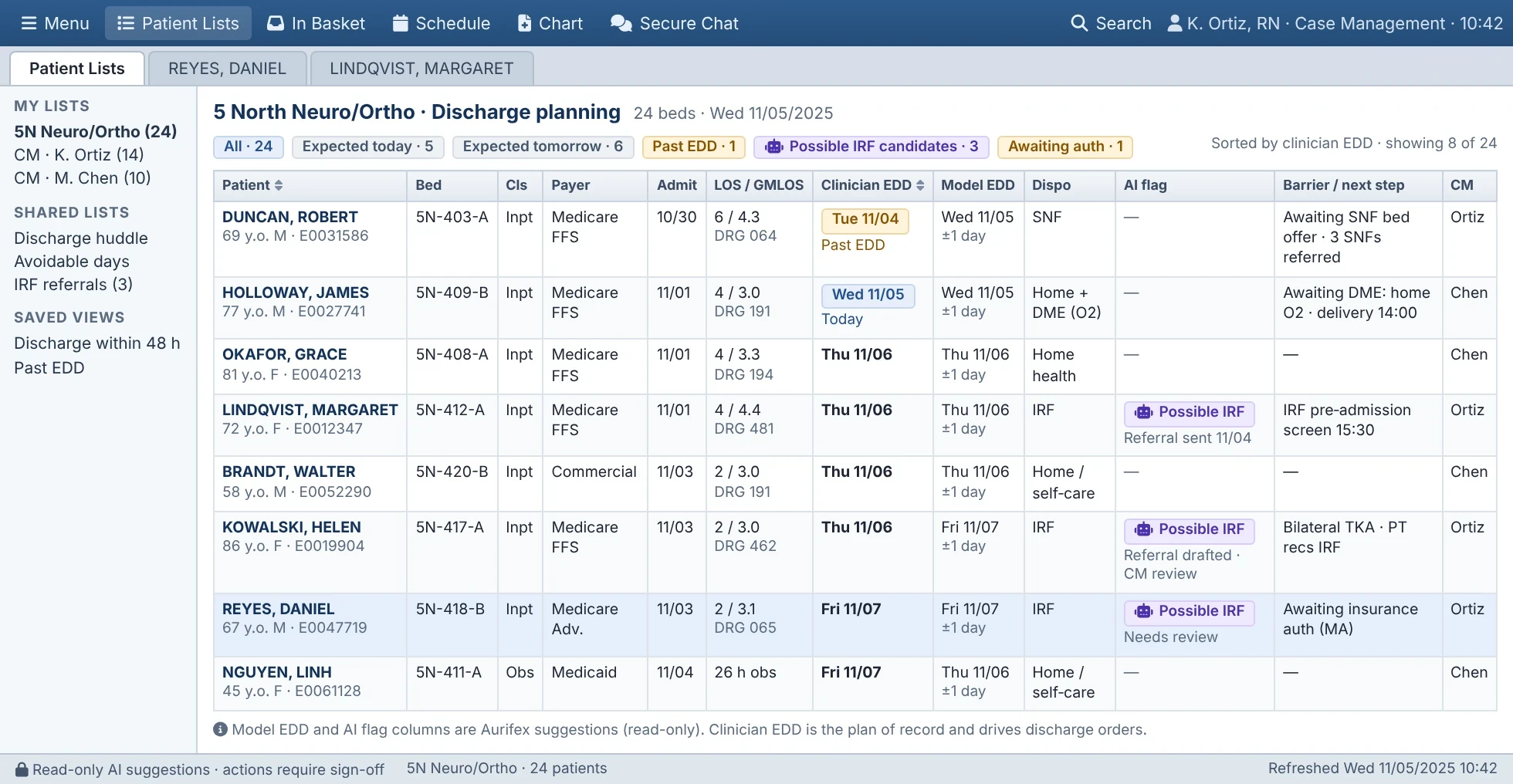
- 1 The model date fills in beside the date your team entered.
- 2 Where the two dates differ, the row shows it.
- 3 A likely next place of care, and a flag where rehab looks likely.
2. A discharge date for every patient, from the second day
A discharge date for every patient, from the second day
Planning usually starts when the patient is nearly ready. Aurifex Healthcare gives every patient an expected discharge date and a likely next place of care early in the stay, so the plan starts while there is still time to change it.
The date beside the one your team entered
The model’s date sits next to the date a clinician set and never replaces it. The team can see both, see how the model’s date moves as notes arrive, and decide which to trust.
The same two dates also sit in the chart. A side panel shows the hospital day, the clinician date with who set it, the model date with its one day range and the anticipated next place of care, so the team can see where the two disagree.
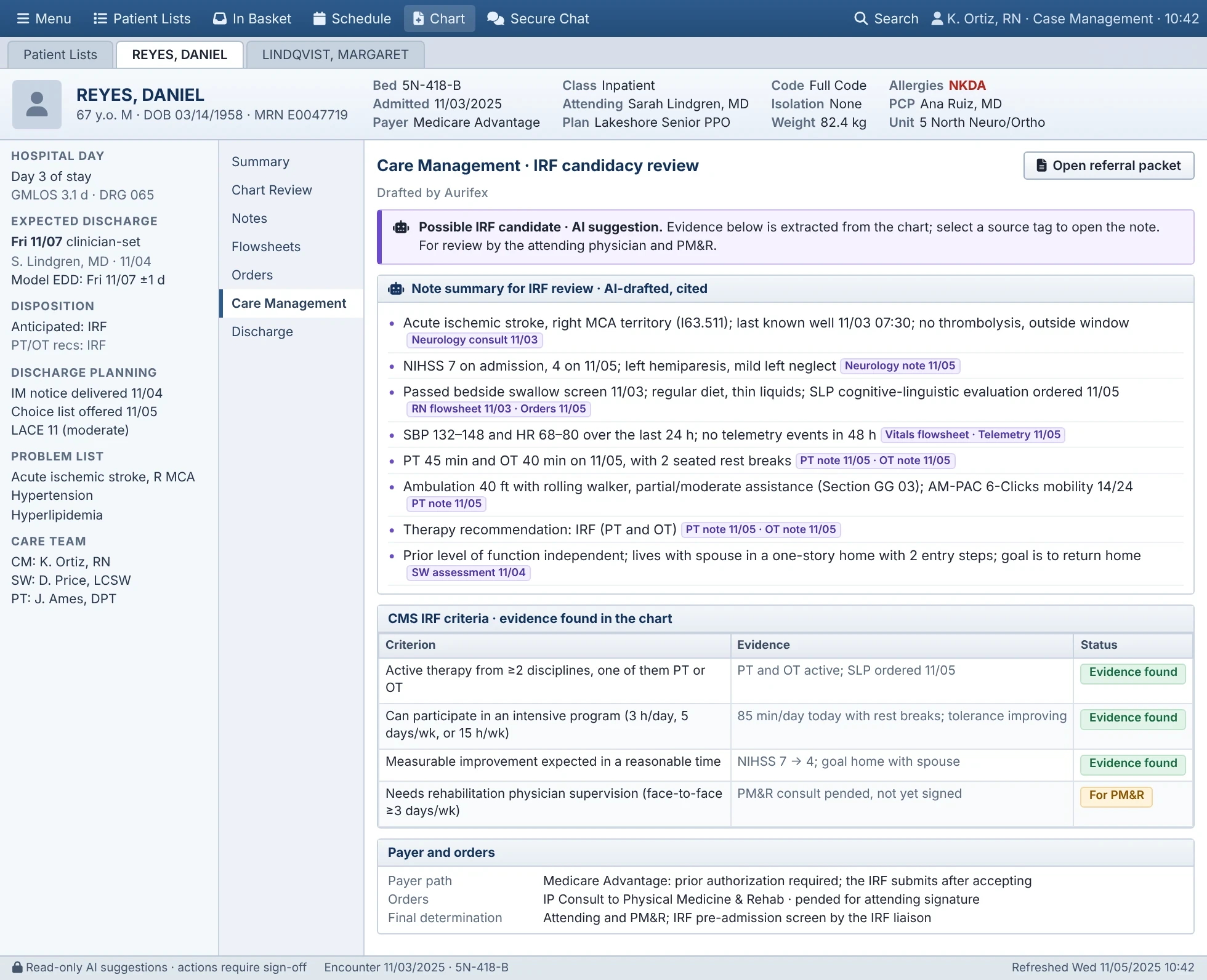
- 1 The day of the stay beside the expected stay for the diagnosis group.
- 2 The clinician date, who set it and when, with the model date under it.
- 3 The anticipated next place, with the therapy recommendation.
3. The rehab candidates find you, and the referral is written
For a flagged patient, the agents have already read the notes and drafted the referral packet with numbered sources. The PM&R consult is a consult request the attending signs, not a PM&R assessment. The case manager reads the packet instead of days of notes, fixes anything wrong, offers the patient a choice of facilities and sends it to the ones they pick.
What stays with people
The rest of the work stays with people. If a patient turns down a facility, the case manager updates the choice list and resends. Medicare Advantage authorizations show as a barrier with their age. If an IRF declines, the packet goes to the next facility the patient chose. Denials, peer-to-peer reviews and appeals stay with the hospital’s utilization review team.
The rehab candidates find you
Finding who qualifies for inpatient rehab means reading days of notes for every patient. The agents read them each morning and bring forward the few who look like candidates. Each flag lists the evidence for the coverage criteria and the note it came from, so the case manager starts from reasons, not from a score.
- 1 The flag is a suggestion for a physician to review.
- 2 Every line of the summary names the note it came from.
- 3 The evidence is laid against each coverage criterion.
A flag is a prompt to look, not a decision. Four people act on one flagged patient, and each decision stays with the person responsible for it. Aurifex Healthcare lays out the evidence and drafts the consult and the packet. The attending signs or declines the consult, the physician in PM&R determines candidacy, the case manager reviews, edits and sends the packet, and the rehab facility screens every referral and decides admission. The agents take none of those steps.
The referral is written, and every line shows its source
A rehab referral usually means a long stretch of reading and retyping. Aurifex Healthcare drafts the packet and the consult from the notes already in the chart. Each statement carries the note it came from, so review is a matter of checking, not searching. The packet also lists the patient’s choice of facilities and the checks to complete before anything is sent, and the case manager can edit any line or reject the draft.
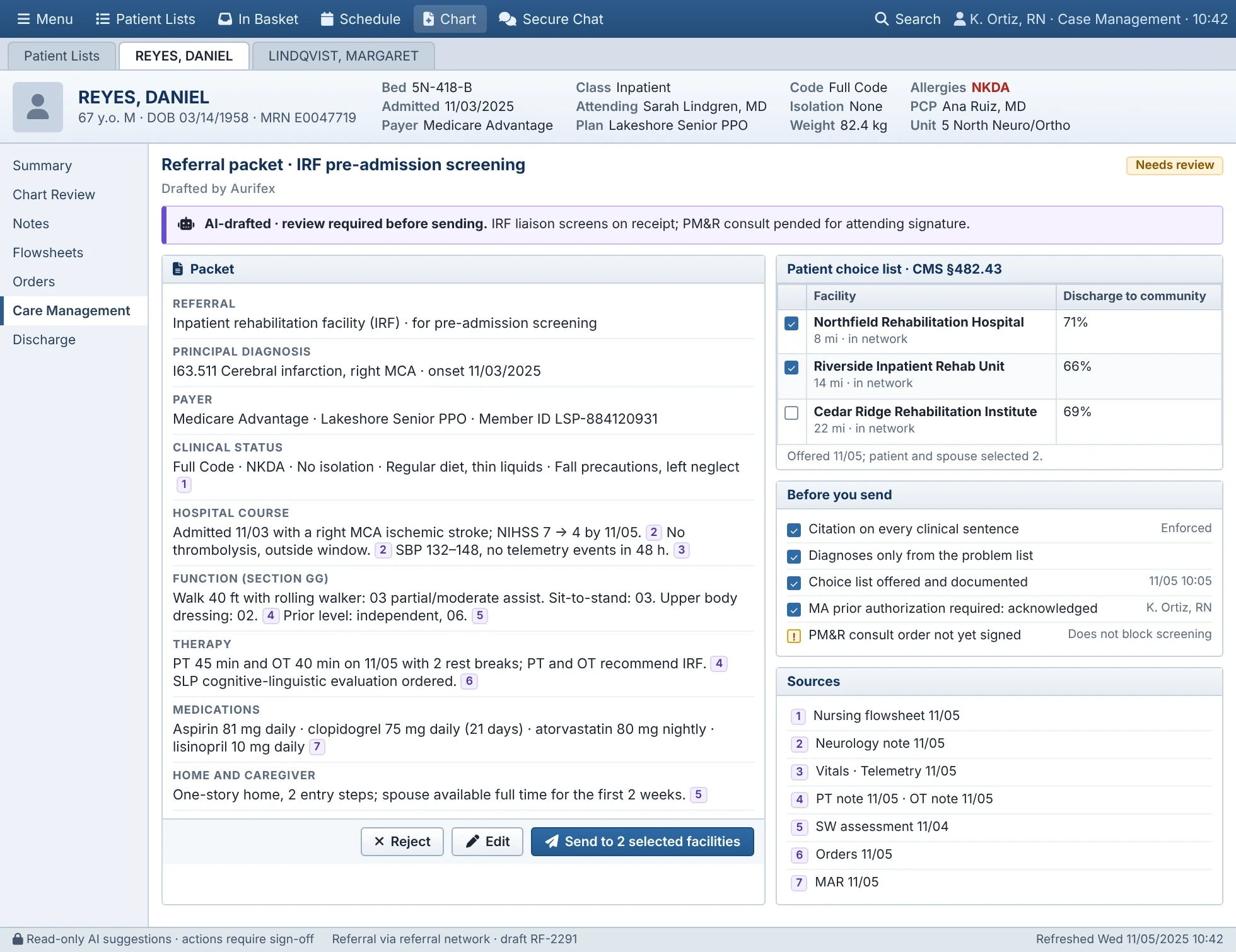
- 1 Every clinical sentence carries a citation number.
- 2 Each number leads to the note it came from.
- 3 The checks are listed before anything can be sent.
4. Nothing leaves without a person, and one board for the huddle
Nothing leaves without a person
The agents read, summarize and draft. They never sign an order and never send a referral. A case manager approves each packet and the attending signs each consult, or edits it, or declines it. The choice stays with the people responsible.
One board for the morning huddle
The same delays hold discharges again and again, and nobody owns the list. The unit view shows the expected discharges for each day and every barrier in the way. A pending bed offer, an authorization or an equipment delivery sits on the board with the person who owns it and how long it has waited, so the huddle spends its time on the right patients. The same view counts who is on the unit, who is expected out and who is past the expected date, and it shows the dates clinicians set for the coming days apart from later estimates.
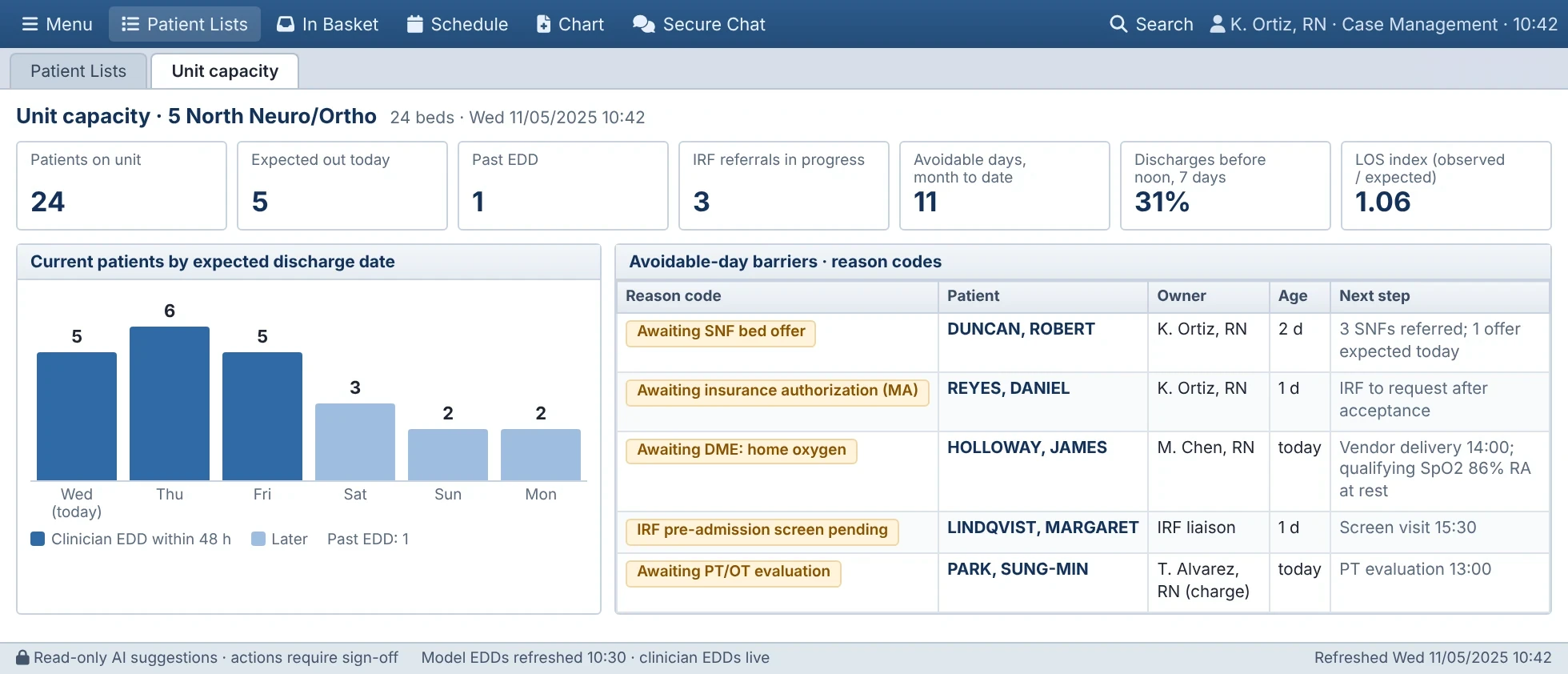
- 1 Expected discharges for each day of the week.
- 2 Every barrier names its owner and its age.
- 3 The next step is written beside it.
5. How it works, and how it is checked
Notes, orders and admission events from the chart feed one set of dates, flags and barriers. The same values then travel to four views, which are the worklist for case managers, the pended consult for physicians, the unit view for unit leaders and the dashboard for executives.
Two kinds of AI do two jobs. The discharge date comes from a gradient-boosted model trained on historical admissions and designed to be refit on each hospital’s own history, because the inputs are structured and the answer can be checked against the real discharge a few days later. Dates are made on admission and revised as notes arrive. The note work uses GPT-4o agents, because the evidence an IRF wants (how far a patient walks, how much therapy they tolerate, who is at home) lives in free text. The agents use the CMS coverage criteria as a guide. The CMS-13 list sets an IRF’s compliance threshold, not a patient’s eligibility, so patients with other diagnoses can be flagged. Flags sit in worklist columns, with no pop-up alerts at the bedside.
How it connects to Epic
Through standard interfaces, an HL7 v2 ADT feed reports every admission, transfer and discharge, and FHIR R4 APIs supply encounters, conditions, vital signs, labs, medication orders, coverage and clinical notes, on Epic 2023 and later, through the hospital’s own Epic build. Each part of the system requests only the data its task needs. It is not an app hosted by Epic, and no Epic partnership or listing is claimed. Day-to-day work happens in the Epic worklist, the chart and pended orders, so teams learn no new application.
It lives where your team already works
There is no second screen and no separate login. Flags, dates and drafts are built to appear in the worklist, the chart and the pended orders the teams already use every day. It reads notes and orders; it writes three worklist columns, a pended order and the packet as a document.
- 1 It sits in the patient list your case managers already open.
- 2 Three added columns. Nothing else on the screen changes.
- 3 Suggestions are read only. The clinician date stays the plan of record.
Evaluation covers what a case manager sees, not only the model. Every change must pass a 1,200-case evaluation gate before it merges, covering accuracy, source checks, 40 prompt-injection tests, and no more than a 3-point accuracy gap across age, sex and race groups. A sample of drafts is also reviewed by people every week: a line the chart does not support is caught and named, and the finding is recorded with its severity before anything is sent.
Guardrails built into the product
Responsible AIAgents read, flag and draft. Referrals wait for a case manager, and consults wait for the attending’s signature.
A BAA is signed before any patient data is shared, data is encrypted in transit and at rest, each agent sees only what its task needs, and agent actions are logged.
Clinicians see the basis for every flag and date. Self-assessed against the Cures Act criteria for non-device clinical decision support; legal review comes before any hospital rollout.
Flags and dates are checked by patient group (ACA Section 1557 applies). In testing, the largest accuracy gap across age, sex and race groups was 3 points or less (smallest group 900 admissions), and results go to each hospital’s compliance team.
Gates before go-live, monitoring after
Before a model or prompt reaches clinicians, it is tested against an evaluation set and has to pass every gate. The levels are set with each hospital and written into the pilot plan.
| Gate | Level | How it works |
|---|---|---|
| A source on every clinical sentence | Enforced | An automated check removes statements without a source before a person reviews the draft. |
| Hallucination rate | ≤ 2% | Counted per drafted statement, to start. The final level is agreed with the hospital. |
| Critical omissions | None | Allergies, code status and isolation are checked against the chart before a packet can be sent. |
| Accuracy | No drop | Discharge-date accuracy and flag agreement at or above the current version, overall and for each patient group checked. |
| Balancing measures | ≤ 1 pt | 30-day readmissions no more than 1 point above the hospital’s baseline to start. If crossed, the feature pauses. |
| Go-live sign-off | Both | The hospital and Aurifex Healthcare both sign off before clinicians see anything. |
Fairness is checked by patient group, with the smallest group in testing at 900 admissions. Race, ethnicity and preferred language are not model inputs. They are used only to check fairness. Before go-live the review also covers traditional Medicare and Medicare Advantage, dual-eligible patients, patients 85 and older and patients with a disability.
After go-live the same measures are monitored weekly. A feature that drifts below the agreed level pauses until a reviewed fix is released, starting with a 5-point drop in within-one-day accuracy over 2 weeks. Clinicians review a weekly sample of drafts and flags with patients hidden. Nothing changes in production automatically.
- Pause any feature. A flag, a draft type or the whole product, effective immediately.
- Approve every release. No model or prompt release goes live without the hospital’s written approval. A new language-model version counts as a release.
- Roll back. Any release can be rolled back to the previous version within one business day.
- See the edit rates. Edit rates for each reviewer, including drafts approved with no edits, are reported during a pilot.
Results, what I learned and what is next
The test set is 25,000 de-identified historical admissions held out from training, plus expert-labeled reference cases and simulated referral work.
| What was tested | Result | How it was measured, and how to read it |
|---|---|---|
| Expected discharge date | 85%+ | 85.3% (95% CI 84.9–85.7%) within one day of the actual discharge on 25,000 held-out historical admissions, measured from day 2 of the stay. Mean absolute error 0.6 days. Clinician-entered expected dates on the same admissions, where recorded (n = 14,200), reached 58% within one day. |
| Rehab-candidate flags | AUROC 0.91 | On 2,000 reference admissions labeled independently by 3 PM&R physicians and 2 case managers (kappa 0.82; 12% candidates). AUROC 95% CI 0.89–0.93. At the worklist threshold, 88% recall and 80% precision; 95% overall agreement with the labels. Precision depends on how common candidates are, so a unit with a different mix will see a different figure. |
| Drafted PM&R consults | 85% | 400 drafts rated acceptable as written or with minor edits in blinded review by 6 clinicians (3 PM&R physicians, 3 case managers), two per draft (kappa 0.78); 95% CI 81–88%. Acceptable isn’t the same as correct, so the type of each edit is reviewed too. |
| Hallucination rate | 1.5% | 1.5% of 6,000 drafted statements (95% CI 1.2–1.8%) unsupported by their cited source. Counted per drafted statement, so not comparable to UW Health’s per-reviewed-draft rate. Every statement cites its source note, an automated check runs first, and reviewers then check that the cited text supports the statement. |
| Referral prep time | 45 → 10 min | Median time per IRF packet across 60 simulated cases timed with 6 case managers, including the reviewer’s check. IRF packets only. |
| Model cost | $0.12 | Average model cost per patient, excluding hosting. |
| Draft time (sandbox replay) | < 30 s | Time to draft a referral packet. |
| Worklist update (sandbox replay) | < 5 min | From an admission event to an updated worklist. |
A case manager can open the candidacy review for any patient, and a patient who isn’t flagged is referred through the usual process. In testing the flag caught 88% of candidates at the worklist threshold. Missed candidates are a standing category in the weekly clinician review.
Read each result above with these limits. They come from the table notes and the test set, gathered in one place.
Limits
Where the numbers come from
Held-out historical data: 25,000 de-identified admissions held out from training, plus expert-labeled reference cases and simulated referral work.
Flag precision depends on the mix
Precision depends on how common candidates are, so a unit with a different mix will see a different figure.
Acceptable is not the same as correct
Drafted consults were rated acceptable as written or with minor edits, which isn’t the same as correct, so the type of each edit is reviewed too.
Rates that are not like for like
The hallucination rate is counted per drafted statement, so it is not comparable to UW Health’s per-reviewed-draft rate.
Scope of the time and cost figures
Referral prep time covers IRF packets only and was timed on simulated cases. Model cost is an average per patient and excludes hosting.
Still open
Whether discharges before noon and emergency department boarding change, and how much staff time Aurifex Healthcare takes beyond referral prep.
What I would do differently
- Test in real workflows early. Simulated cases time referral prep well, but only a busy unit shows how the worklist gets used, so live-workflow measures belong in the plan from the start.
- Design the balancing measures in from the start. Readmissions and emergency returns are the check that a shorter stay isn’t a worse outcome. I’d define them, and how they’re reported, before anything goes live, so a length-of-stay result always arrives with its safety check.
- Scope skilled nursing and home health earlier. IRF was the right first referral because it is evidence-heavy and well defined, but SNF and home health are most of a case manager’s referrals. I’d have started that design work sooner.
- What carries over. The evaluation gate, the cited-draft review pattern and the check for unsupported statements apply to any AI that drafts work a person must approve.
What I would do next
- Run the planned pilot on one unit, starting in silent mode, so predictions and drafts are compared with what happened before anyone sees them.
- Define the balancing measures, readmissions and emergency returns, and how they are reported, before anything goes live.
- Start the skilled nursing and home health design, which is most of a case manager’s referrals.
Reports
Each report below says what it covers and what it does not.
- The evaluation report. What was tested, on what, and what the limits are.
- The safety and monitoring note. The gates before a change reaches clinicians and the monitoring after.
The evaluation report
This report summarizes the evaluation. The date model, the rehab flags and the drafted referrals were tested on held-out historical admissions, on expert-labeled reference cases and on simulated referral work, and the results table above gives each measure and how to read it. A case manager can open the candidacy review for any patient, and a patient who is not flagged is referred through the usual process.
It covers what was tested. Whether discharges before noon or emergency department boarding change, and how much staff time the product takes beyond referral prep, are still open.
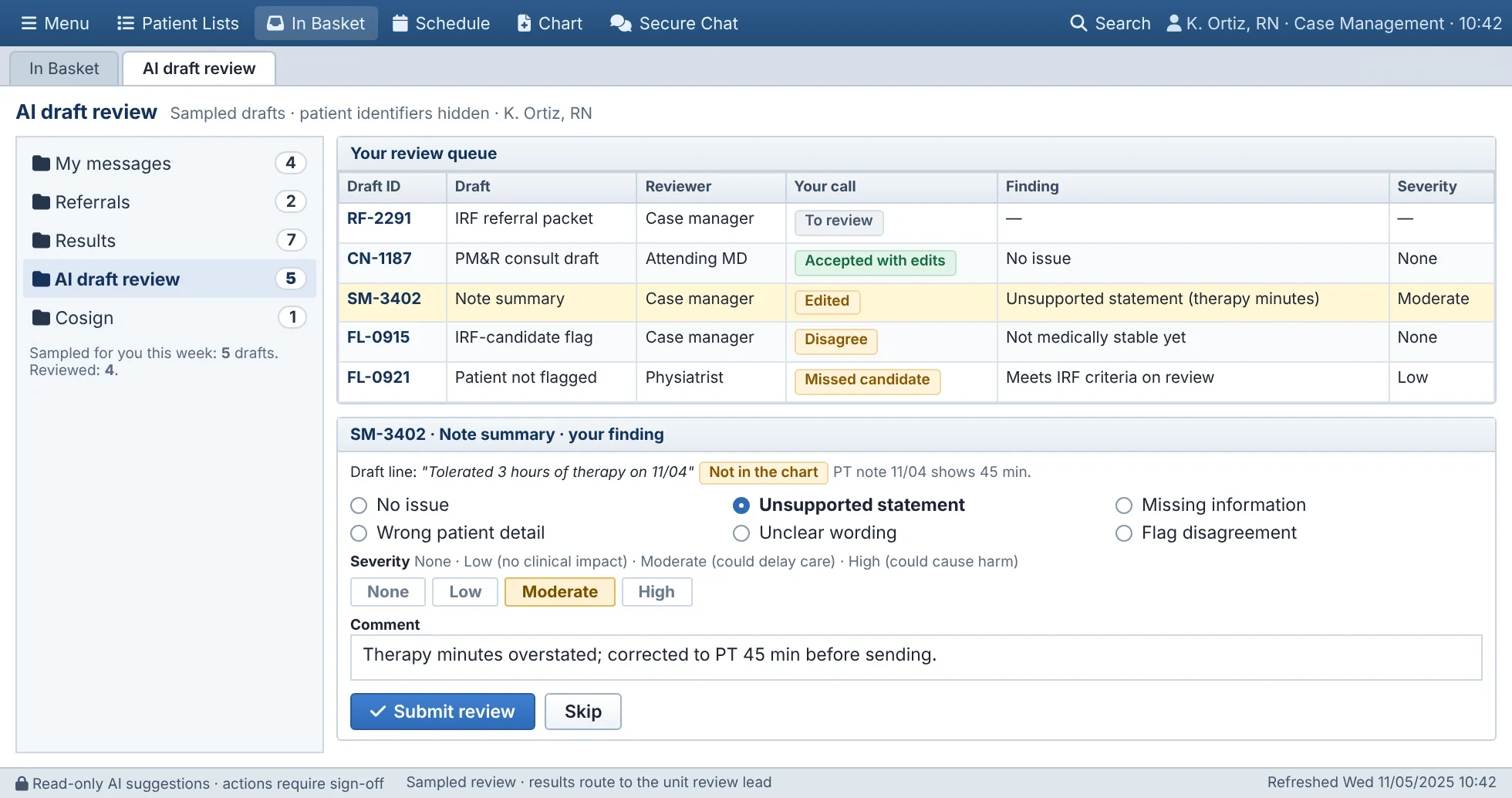
- 1 A sample of drafts is reviewed by people every week.
- 2 A line the chart does not support is caught and named.
- 3 The finding is recorded with its severity before anything is sent.
The safety and monitoring note
This note summarizes the guardrails. Agents read, flag and draft, and nothing leaves without a person. A case manager approves each packet and the attending signs the consult. Every change passes an evaluation gate before it merges, a source check removes statements the chart does not support, and fairness is checked by patient group. After the pilot starts, drift pauses a feature and a rollback restores the last good version, and any feature can be paused immediately.
It covers the design of the gates and the monitoring. Levels are set with each hospital and written into the pilot plan.