At a glance
- Product
- Gallify, an AI-powered iOS marketplace for digital art with AR viewing, where artists publish a gallery from a phone and collectors hang a piece on their own wall before bidding.
- My role
- Chief Product Officer & Co-Founder, AI/ML, covering product and engineering, the product priorities, the engineering standards and the decision to broaden from digital art to public art.
- Timeframe
- 2016 to 2021.
- Status
- Designed, built and launched ahead of schedule, grown to 7,500+ users, and in 2021 broadened from digital art to public art, which became CODAmarket.
OutcomeA marketplace that grew about 15% a month, mostly organically, with a recommender that lifted click-through 30% and average order value 20%.
- 7,500+ users (2,500+ artists and 5,000+ buyers).
- Computer-vision auto-tagging cut the time to list a piece by 60% and lifted search conversion 25%.
- Investment secured from a Midwest venture capital firm.
Reports at the end of the page are how it was measured and the move to public art.
The case in brief
- Problem. Digital art had no place that felt like a gallery, and collectors could neither see a piece in their own room nor prove they owned it.
- Bets. Discovery over search, AR at real size, ownership a collector can verify, computer-vision auto-tagging, and a recommender that builds a feed for each collector.
- My part. I led product and engineering as Chief Product Officer and co-founder, set the product priorities and engineering standards, and recommended broadening from digital art to public art.
- Outcome. The feed and the auto-tagging moved the measures we set for them, the user base kept growing, and in 2021 we broadened to public art with CODAworx.
- Lesson. Before building a large feature I now test demand first with something much cheaper.
The problem and who has it
In short. Digital art had nowhere that felt like a gallery, and collectors could neither see a piece in their own room nor prove they owned it. We built an iOS marketplace where an artist publishes a gallery from a phone, a collector hangs a piece on a wall in AR at its real size and bids from their own wallet, and a recommender builds a feed for each collector. The call that shaped it was discovery over search. In the end we recommended moving into public art, which became CODAmarket.
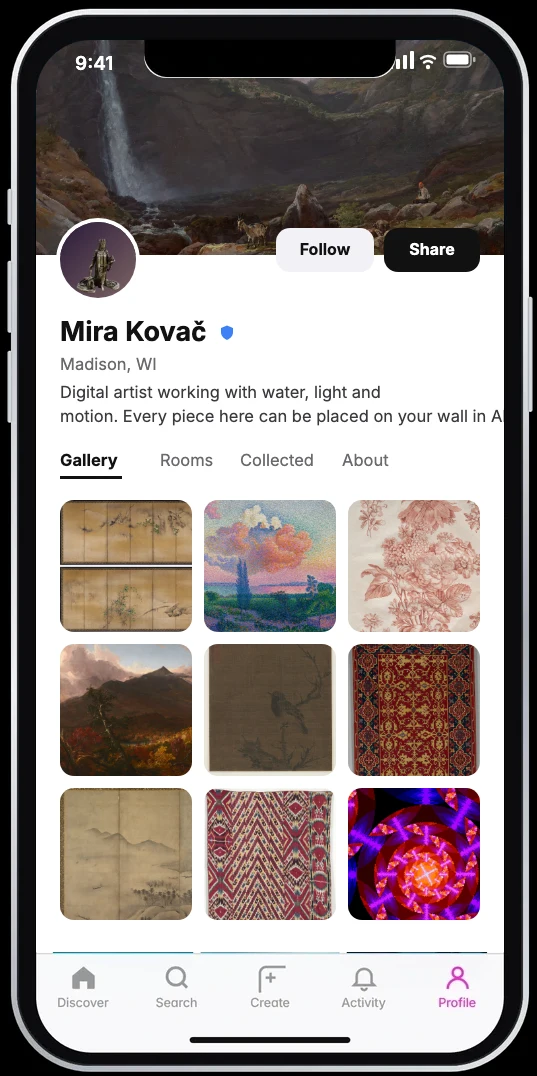
Digital artists had nowhere to show and sell their work that felt like a gallery. Collectors couldn’t see a piece in their own space, and couldn’t prove they owned it. So we built an iOS app with galleries you could create and share in minutes, AR to see any piece on your wall at its real size, and ownership recorded on a blockchain.
Back then digital art mostly lived on social feeds built for photos. Artists could post, but there was no place that treated a piece of digital work with the presence a gallery gives a painting. For collectors there were two gaps. They couldn’t tell how a piece would look at home, which is how most people decide to buy art. And they had no reliable way to prove they owned what they bought.
Our positioning was “a next generation gallery for the digital age”, meaning you create a gallery and share it instantly. We bet that seeing a piece on your own wall and being able to verify you owned it would make digital art feel like it counted, and that good discovery would help collectors find work they’d never have searched for.
Compared with where digital art lived
When Gallify started there was no place built for digital artwork as a work of art.
| Where digital art lived | What it does well | Where it falls short | What Gallify did differently |
|---|---|---|---|
| Social feeds | Huge reach | Built for photos; no sale, no ownership, no room for the piece itself | A gallery an artist builds in minutes and shares with one link, with works that can be sold |
| General online art marketplaces | Established buyers | Mostly physical work; digital pieces fit poorly; no way to see a piece on your own wall | AR view at real size on your own wall before you buy |
| Print-on-demand shops | Easy for the artist | Turns the piece into merchandise | Keeps the digital work as the product |
| Early digital-art marketplaces | Native to digital work | Hard for a newcomer to discover work; little guidance for buyers | A per-collector feed that learns from what each collector views, saves and bids on |
This compares kinds of tools, not named products, and quotes no figures. Only what is true of the whole kind is claimed. Sourced figures for named alternatives will be added when each can be checked at its source.
Problem statement and hypotheses
For artists and collectors of digital art, there was no gallery-like place to show, find, try and own a piece. My working belief was that each missing piece could be answered by one product bet, and that each bet should carry a hypothesis and a way to check it. The table says what each bet was meant to solve and how far we could check it.
| Bet | Problem it answers | Hypothesis | How we checked it |
|---|---|---|---|
| Discovery over search | Collectors rarely know what to search for | A feed built for each collector puts work in front of them that they would never have searched for | Click-through and average order value against the previous feed |
| AR at real size | Collectors could not tell how a piece would look at home | Seeing a piece on their own wall before bidding makes digital art feel like it counts | People loved the moment |
| Verifiable ownership | Collectors could not prove they owned what they bought | A token approved in the collector’s own wallet makes a purchase mean verifiable ownership | It solved the problem of proving ownership |
| Auto-tagging | Artists had to tag every piece by hand | Computer vision can tag 2D and AR/VR work well enough that artists list faster | Time to list a piece and search conversion |
| The recommender | Collectors arrived without a clear idea and every artist wanted to be seen | A feed ranked from behavior and visual similarity is the most valuable thing we can build | Click-through and average order value against the previous ordering |
Discovery over search
Click-through and average order value against the previous feed.
CheckedAR at real size
People loved the moment.
WorkedVerifiable ownership
It solved the problem of proving ownership.
WorkedAuto-tagging
Time to list a piece and search conversion.
CheckedThe recommender
Click-through and average order value against the previous ordering.
CheckedGoals and how success is measured
The goals were to let an artist publish a gallery from a phone in minutes, let a collector see a piece on their own wall at its real size before bidding, make ownership verifiable, and put the right piece in front of each collector.
How success was measured
The feed
Click-through and average order value against the previous feed.
Listing and growth
Time to list a piece, users, and month-over-month growth.
The team
On-time delivery and bug resolution time.
Metrics tree
| Level | Measure | What moves it |
|---|---|---|
| Growth | Users, and month-over-month growth | More artists and buyers arriving, mostly on their own |
| Discovery | Click-through and average order value | A feed that ranks the right piece for each collector |
| The team | On-time delivery and bug resolution time | Regular sprints, one-on-ones and written standards |
Assumptions and what we tested
| Assumption | Tested before building | What we found |
|---|---|---|
| Collectors want to see a piece on their own wall | After the build | People loved the moment |
| Collectors will set up a wallet to own what they buy | After the build | New collectors set one up before their first bid, and we kept the wallet step as clear as we could |
| A feed built for each collector beats the previous ordering | Yes, against the previous feed | Click-through rose 30% and average order value 20% |
| Auto-tagging helps artists list | Yes, on listing time and search conversion | Time to list fell 60% and search conversion rose 25% |
My role and the decisions I made
Gallify started as a small AI-focused team. I joined early and became Chief Product Officer and a co-founder. Over five years I led product, ran engineering through a lot of hiring, and in the end recommended that we broaden from digital art to public art.
I joined early and became Chief Product Officer and a co-founder. For five years I led product, ran engineering through a lot of hiring, and was the main technical decision-maker, which meant setting product priorities and engineering standards. These are the calls I made, and the trade-offs I would flag.
Product decisions
Discovery over search
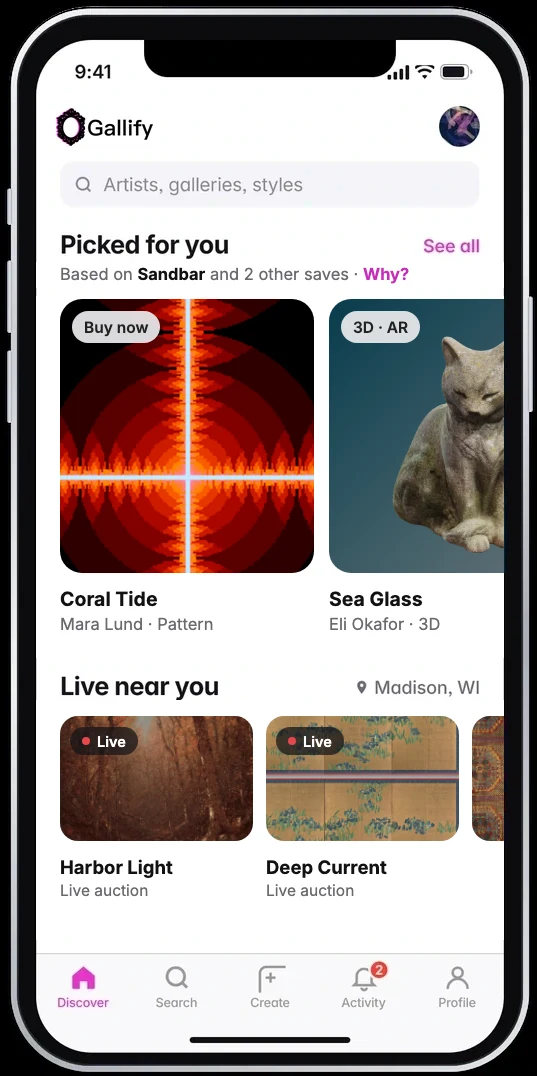
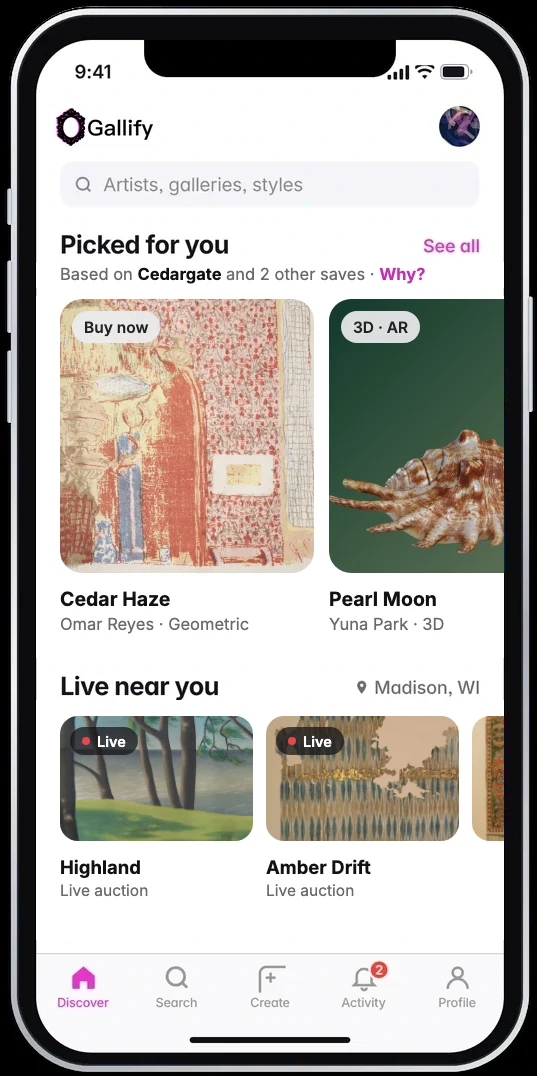
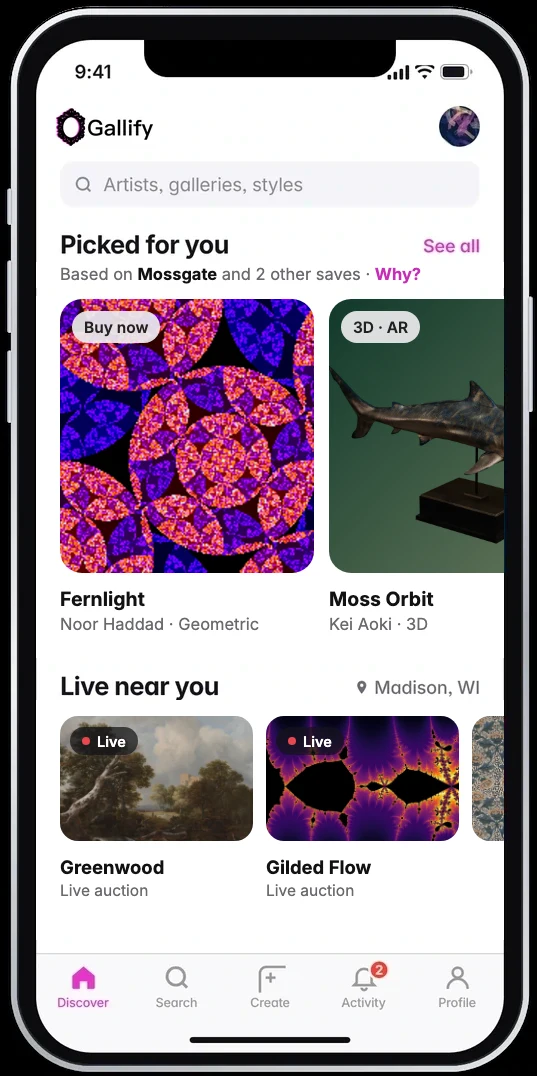
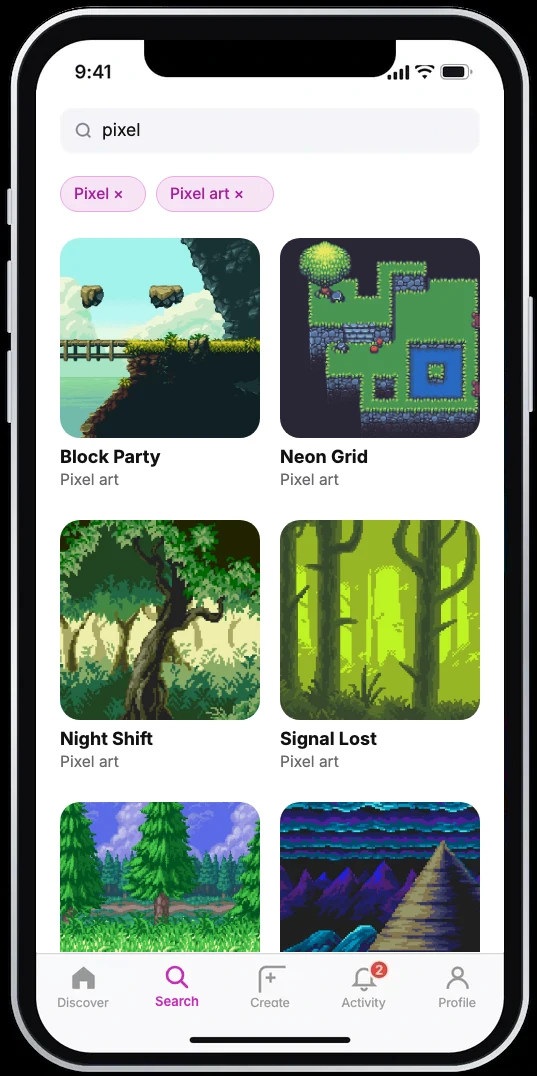
Collectors rarely know what to search for, so the home screen is a per-collector feed with local auctions by city, curated playlists and a featured room, instead of a search bar.
AR as the differentiator
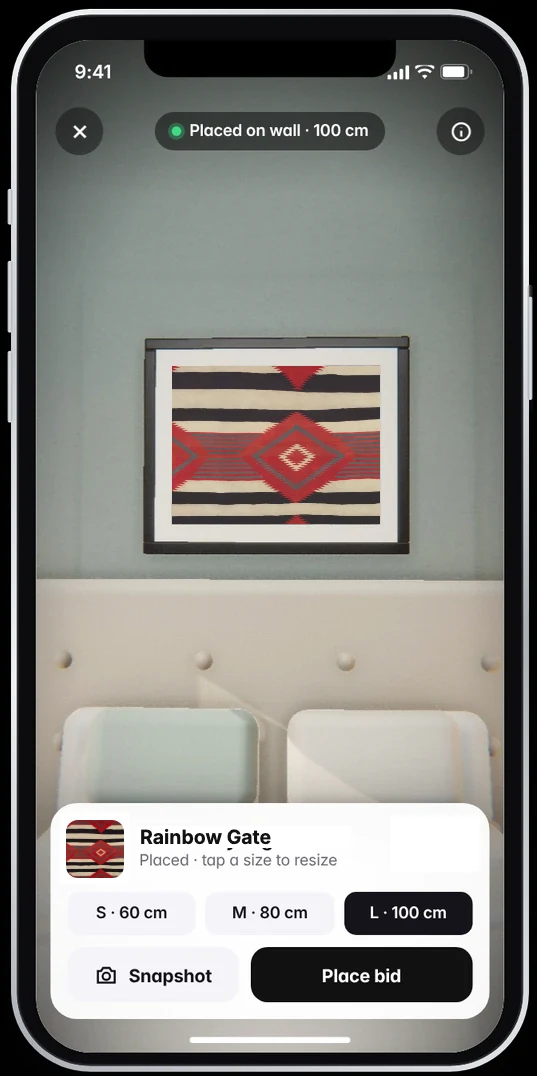
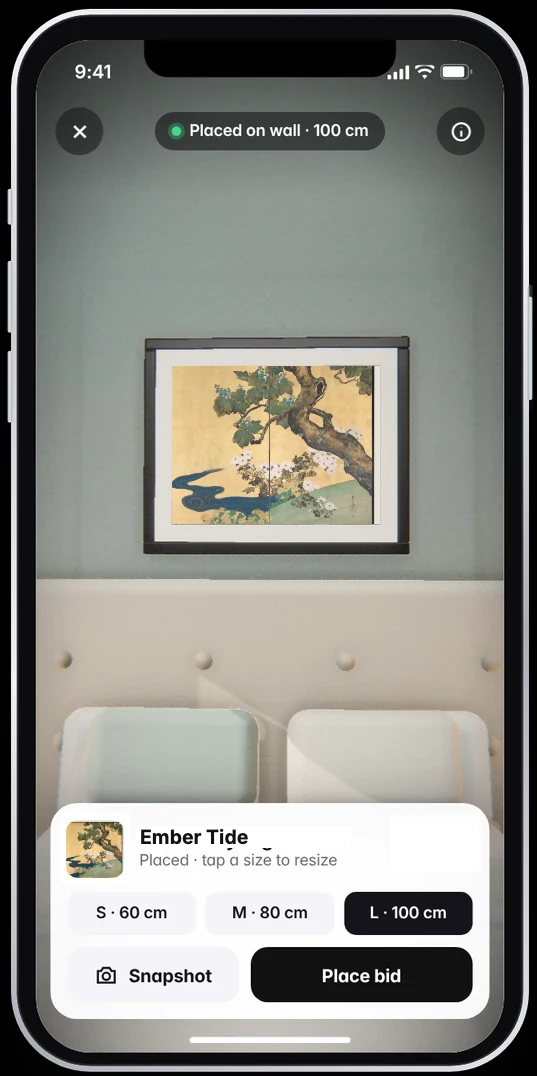
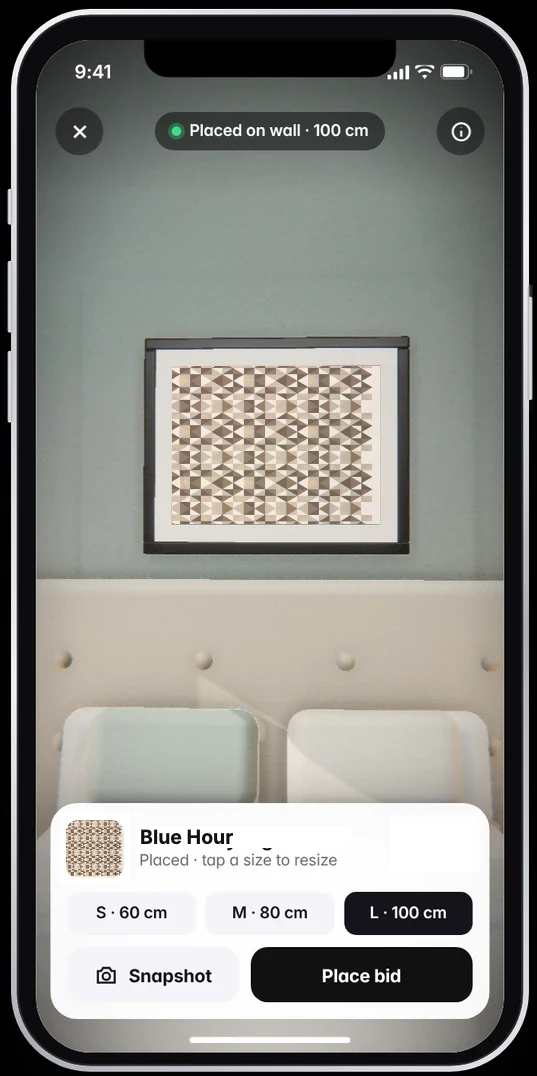
We built on Apple’s ARKit so collectors could place a piece on their own wall at real size before bidding. Later we added Object Capture so artists could scan physical sculptures into 3D and show those in AR too.
Ownership on a blockchain
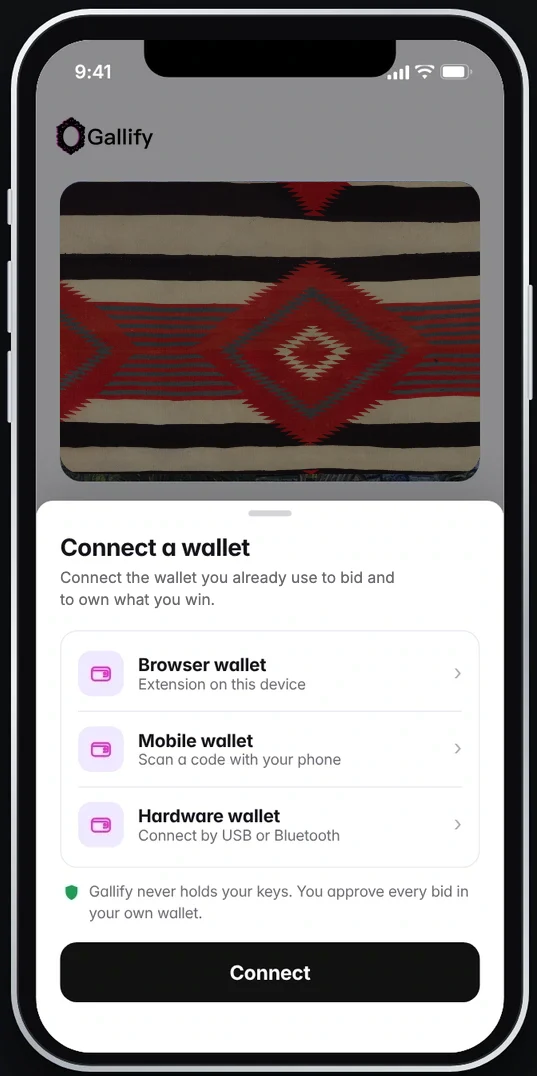
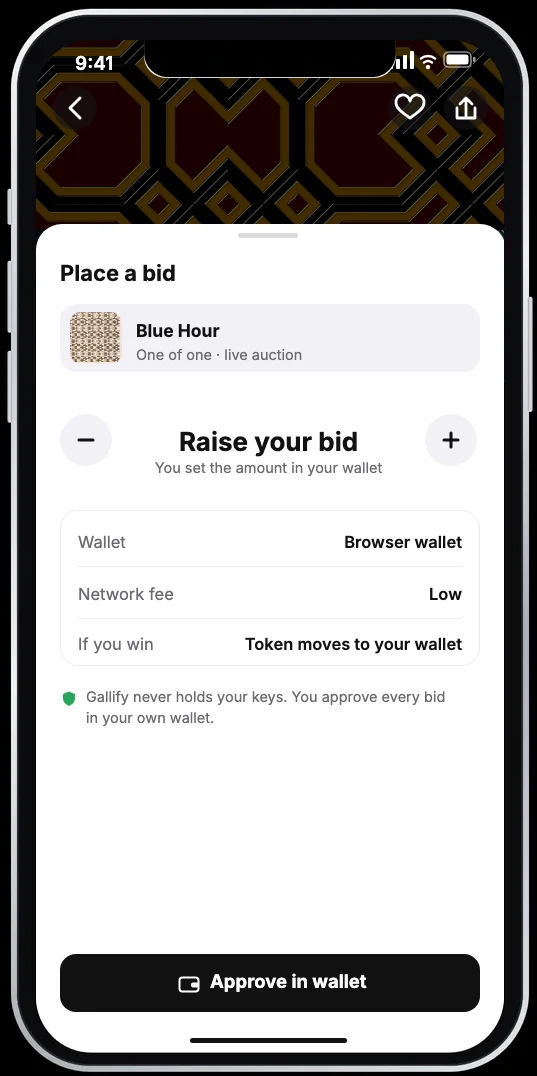
Purchases are tokens on Polygon (an ERC-721 contract written in Solidity) with wallet connect, so a purchase meant verifiable ownership. Polygon’s low fees and fast confirmation suited small first purchases by new collectors.
Collectors keep their own keys
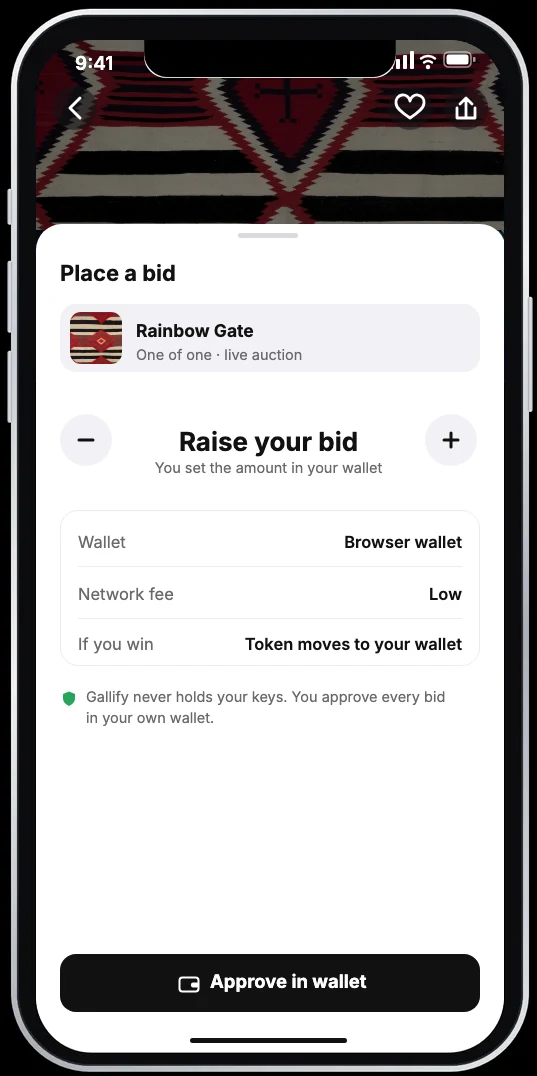
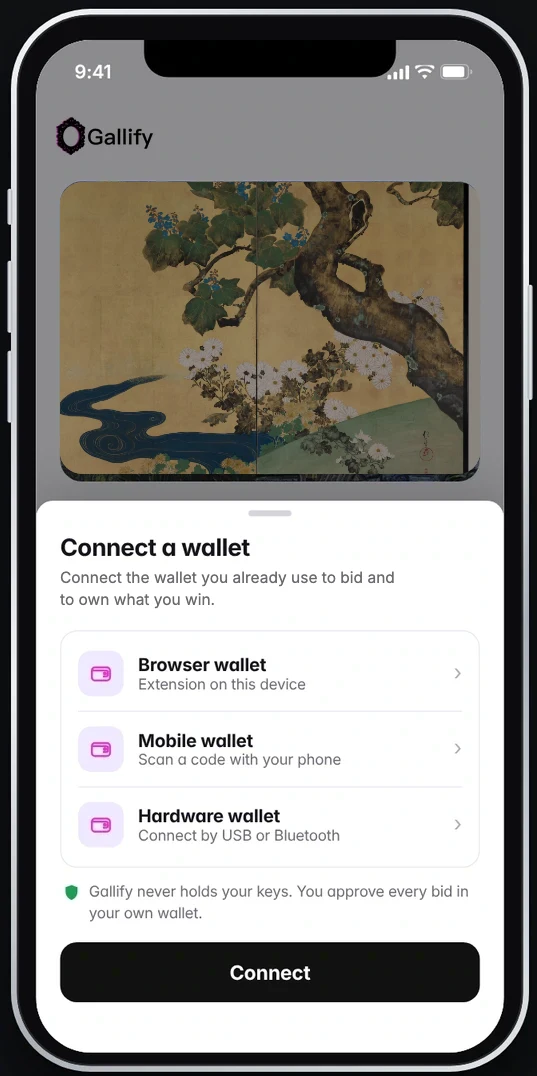
Bids and purchases are approved in the collector’s own wallet. Gallify never holds anyone’s keys, which meant fewer security obligations for us and more trust for them.
Lower the bar for artists
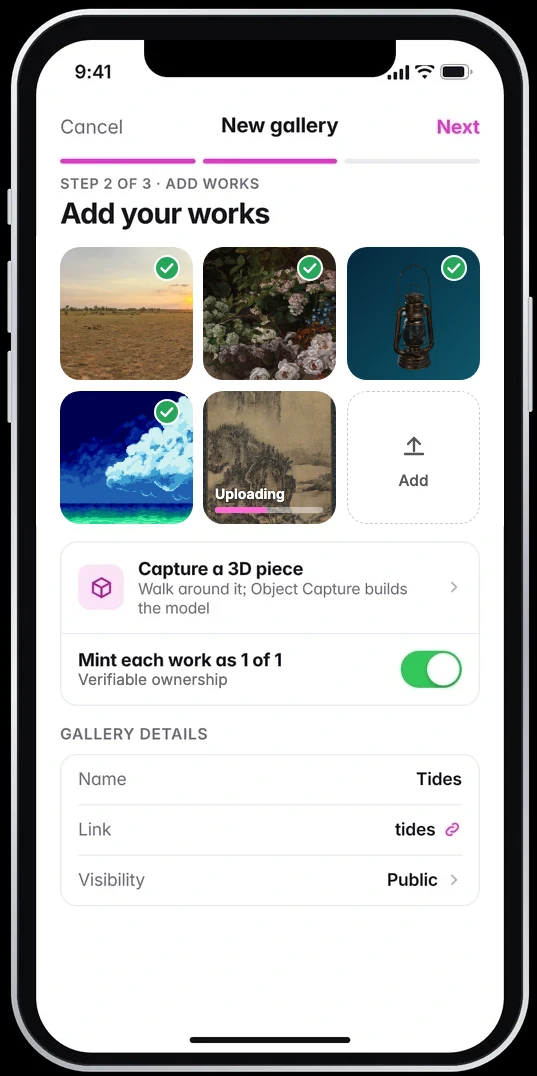
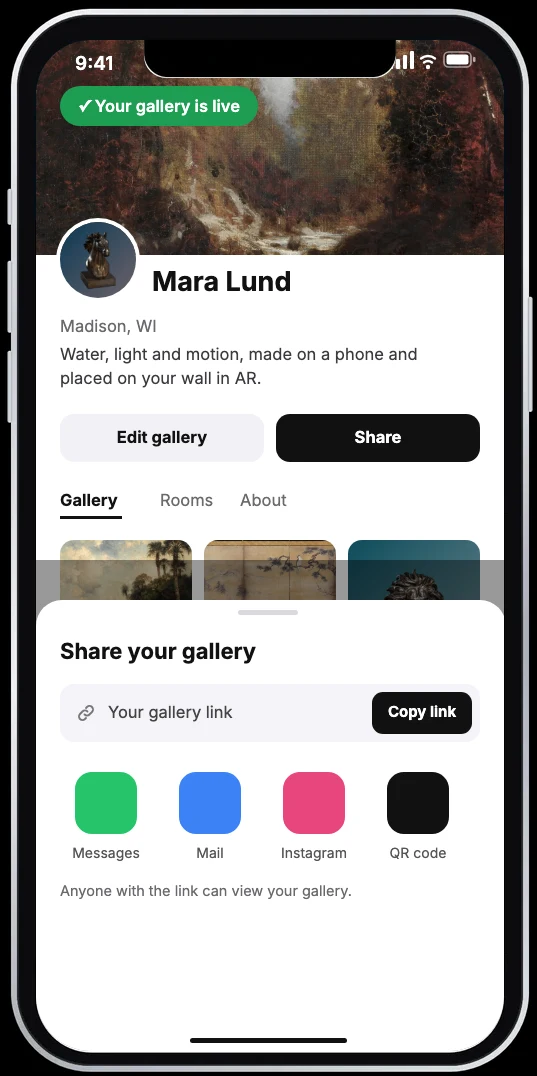
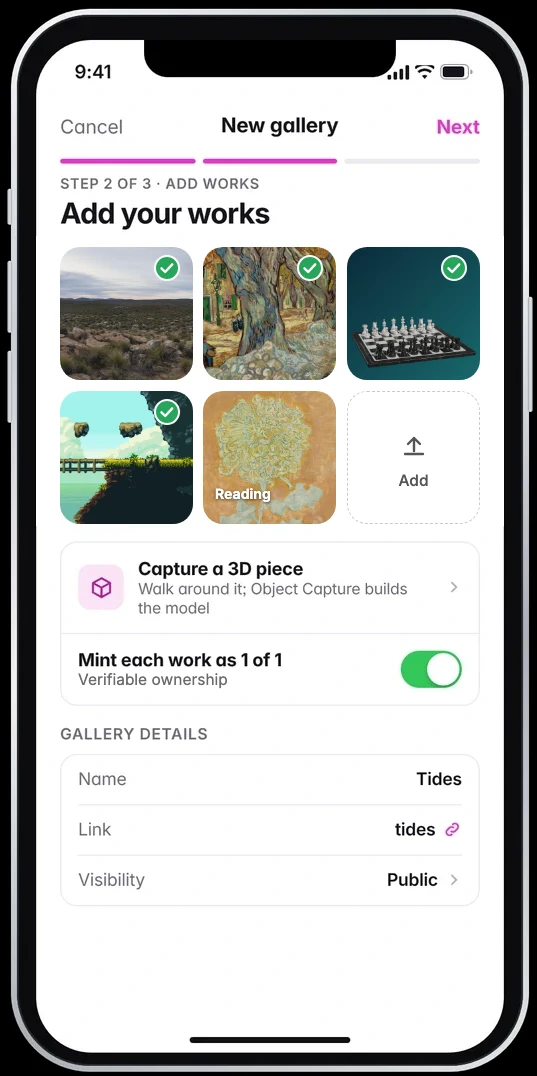
Publishing a gallery from a phone takes minutes, by uploading images or capturing a 3D piece, minting the work as a one-of-one, and sharing one link.
Trade-offs I'd flag
Two of our biggest bets were AR and verifiable ownership.
AR. It was the feature people remembered, and nothing else felt like our product. People loved the moment.
Blockchain. On-chain ownership solved the real problem of proving a piece is yours. New collectors set up a wallet before their first bid, and we kept fees low on Polygon and made the wallet step as clear as we could.
Requirements and priorities
I set priorities by asking what a collector or artist needed before the first bid or the first gallery would work, and what only made it better. The list mirrors the decisions above.
| Priority | Requirement | Why |
|---|---|---|
| Must | An artist can publish a gallery from a phone and share one link | It is the promise on the beta page, and every feature was tested against it |
| Must | A piece can be placed on a wall in AR at its real size | It was the differentiator and the feature people remembered |
| Must | Bids and purchases approved in the collector’s own wallet, minted as one-of-one | Verifiable ownership, and Gallify never holds anyone’s keys |
| Should | A reason for every pick, with controls to see more, see less or hide an artist | Cheap to build, and a clearer signal than clicks alone |
| Not now | A search bar as the home screen | Collectors rarely know what to search for |
Risks and how I handled them
| Challenge | Why it mattered | What I did | Result |
|---|---|---|---|
| Making AR worth the engineering | It was a big engineering investment | Kept it as the feature people remembered and added Object Capture so artists could show physical sculptures too | People loved the moment |
| The wallet step for new collectors | New collectors set up a wallet before their first bid | Kept fees low on Polygon and made the wallet step as clear as we could | Collectors own what they buy, verifiably |
A collector
An artist
Decision log
| Decision | Options | Choice | Why | Rejected |
|---|---|---|---|---|
| Home screen | A search bar, or a feed for each collector | The feed, with local auctions, playlists and a featured room | Collectors rarely know what to search for | A search bar as the home screen |
| Who holds the keys | Gallify holds them, or the collector’s own wallet | The collector’s own wallet | Fewer security obligations for us and more trust for them | Gallify holding keys |
| What to do in 2021 | Keep going on digital art, or broaden to public art with CODAworx | Broaden to public art | The larger market in public art that our partnership had opened up | Another year on digital art |
How it was made
Discovery and early design
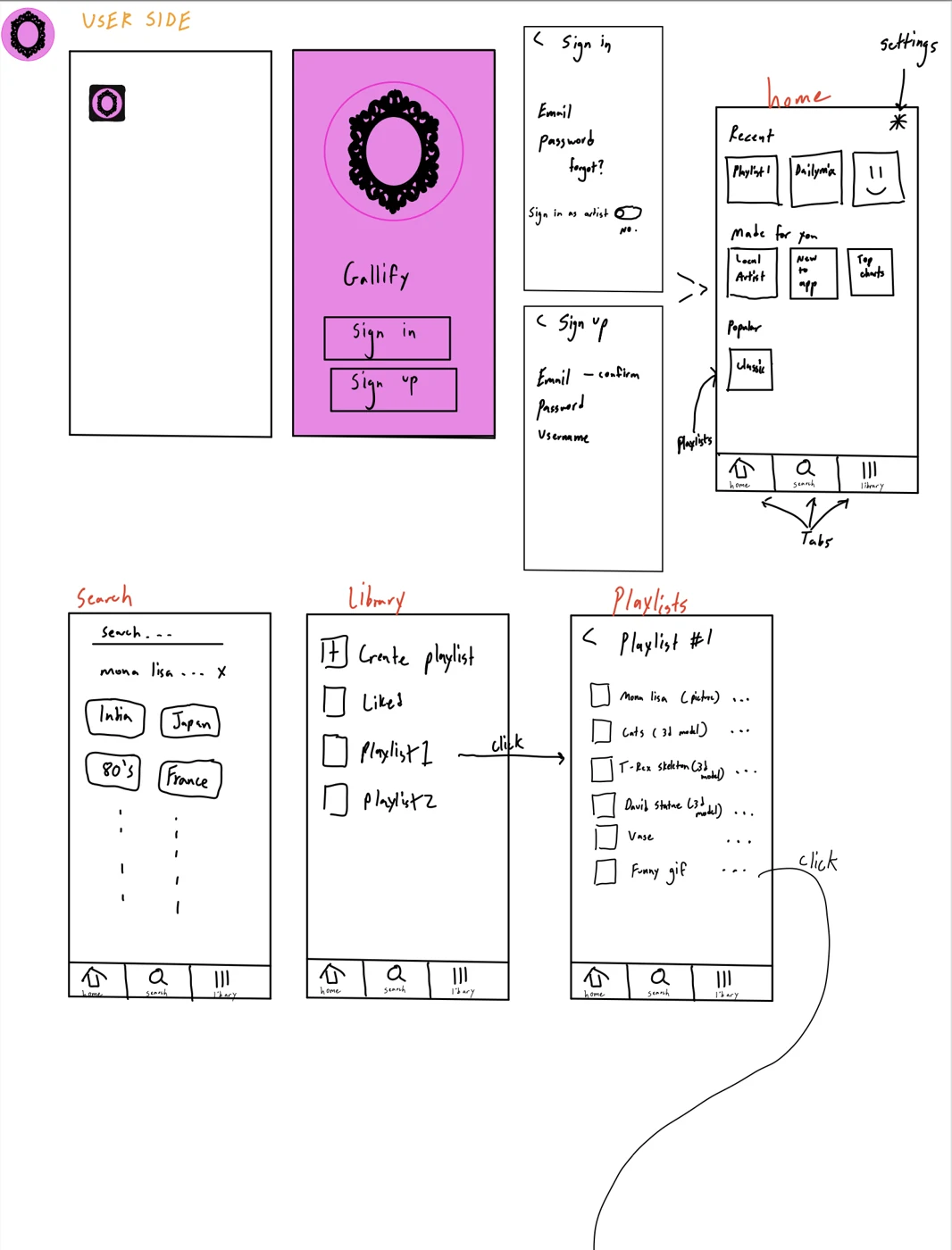
We started with flows before screens. I sketched sign-up, the library, playlists and search by hand and argued over the paths with the team until we agreed on them. Only then did we move to high-fidelity iOS designs, and after that to a beta landing page with a Discord community for early feedback.
The sketches cover what mattered at the start, namely how an artist creates a gallery, how a collector builds a library of favourites, and how playlists let people share taste. A few of those ideas survived and a lot of them didn’t. Starting on paper meant changing our minds cost us nothing.
The beta page said “Create a gallery and share, instantly,” and we used that sentence to test every feature. Did it make the first gallery faster to create, or easier to share?
Running the team
By our busiest period we had six projects running across four sub-teams, 10 people in all. I was Scrum Master and also the main technical decision-maker, which meant setting product priorities and engineering standards. Delivery was unreliable when I took it on. Here’s what I changed.
- Rhythm. I set up regular sprints and one-on-ones, so problems surfaced in a week instead of at the deadline.
- Standards. I wrote down engineering standards, including what “done” meant, so quality didn’t depend on who was reviewing.
- Hiring. I ran the whole process, from sourcing to onboarding, as the team grew from 2 to 10, with 3 reporting to me.
- Onboarding. I documented the codebase and the way we worked so new engineers could contribute sooner.
Who was involved
| Group | Their part in the work |
|---|---|
| The team | 10 people in four sub-teams, working across six projects at our busiest, with me as the main technical decision-maker |
| Artists | Published galleries and wanted to be seen, so the feed and auto-tagging were built for them as much as for collectors |
| Collectors | Set up, discovered, tried pieces in AR, bid and bought, and their views, saves and bids shaped each feed |
| A Midwest venture capital firm | Invested in the company |
| CODAworx | The partnership that opened the larger market in public art and led to CODAmarket |
The solution, step by step
The app, AR and ownership
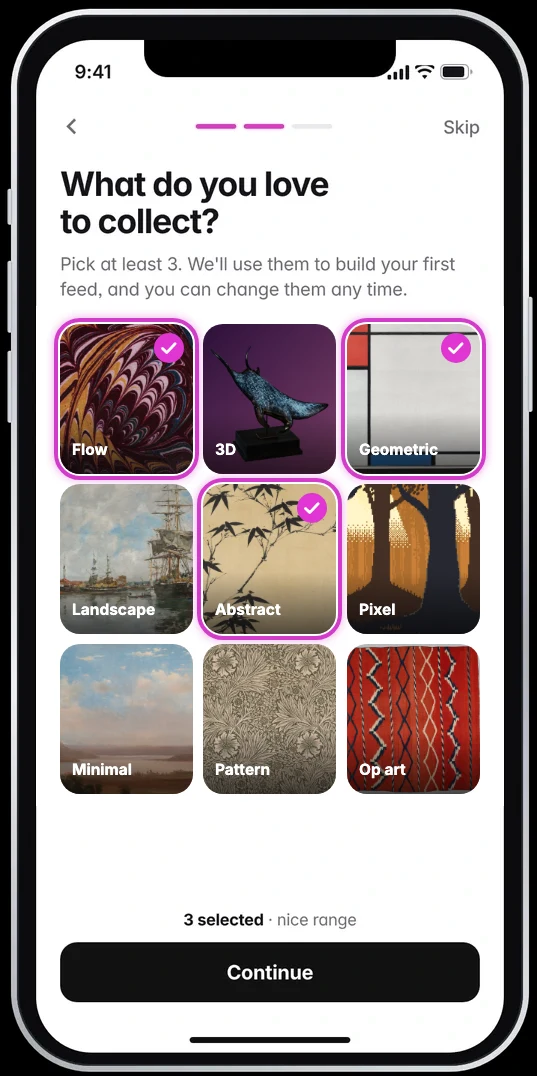
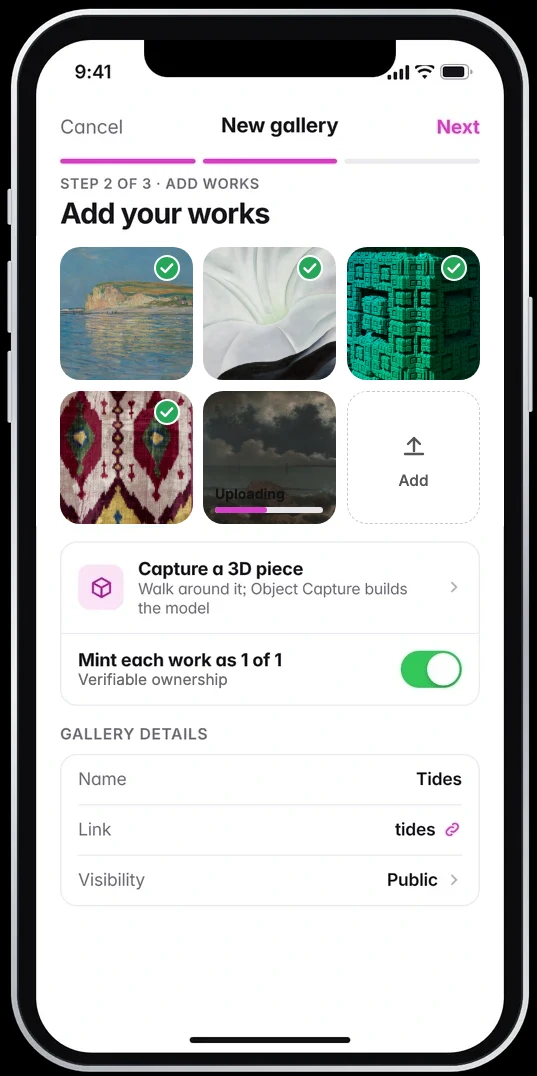
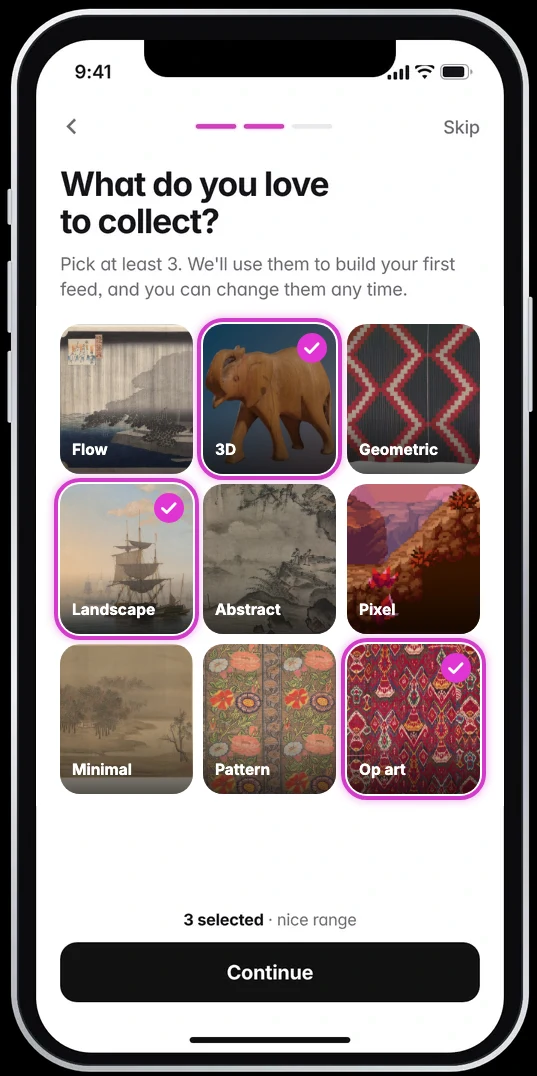
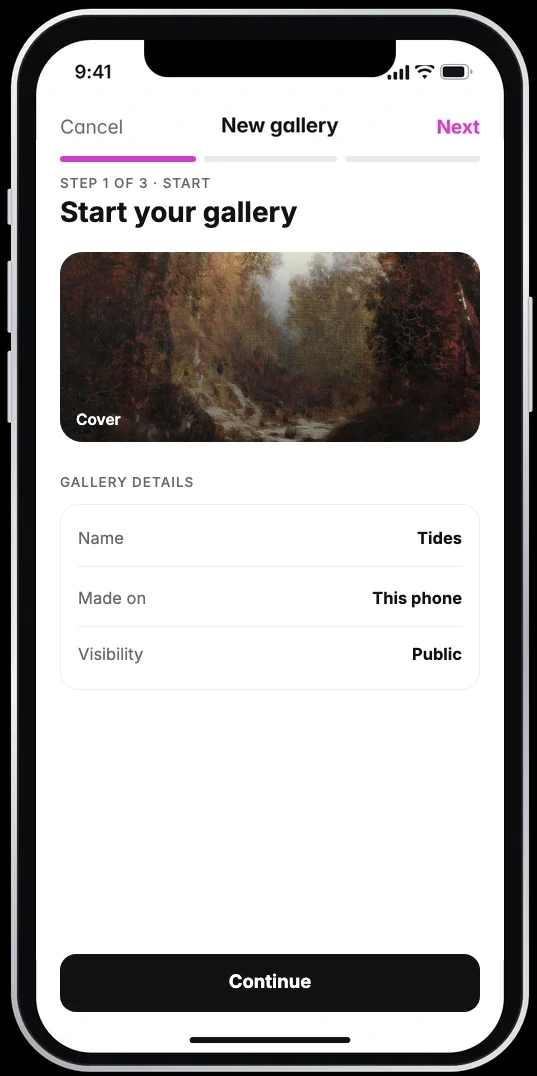
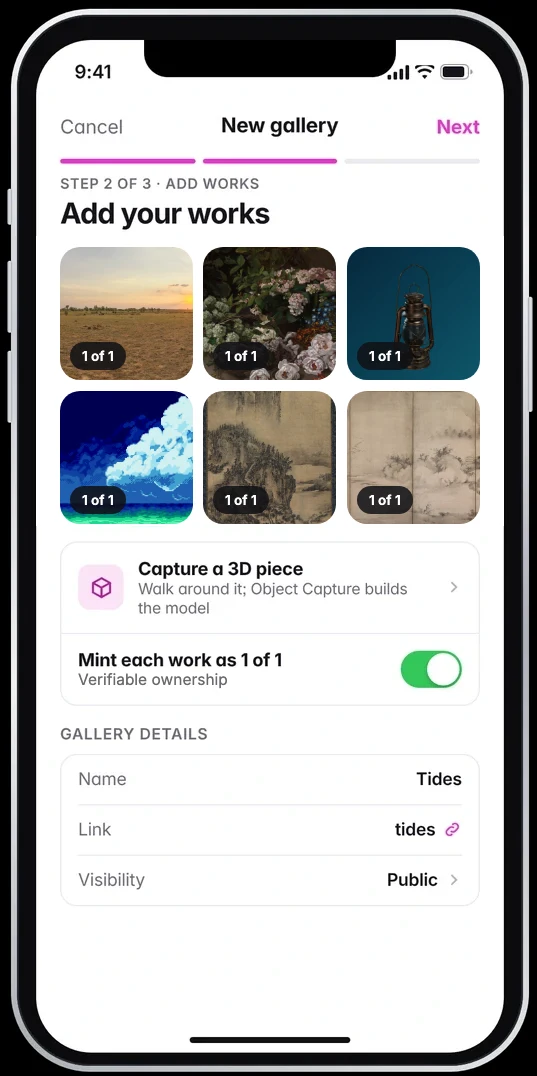
A collector starts by picking the styles they love, and the first feed is built from those picks. An artist starts a gallery by adding works, optionally capturing a 3D piece, and minting each one as 1 of 1 on Polygon.
Four pieces carry the product. The iOS app is where a collector browses and bids, the AR layer shows a piece on their wall, an on-chain token proves they own it, and their own wallet approves every bid.
A collector's journey
- 1
Set up
Pick at least three styles, and the first feed is built from them. That way the feed is never empty on day one.
- 2
Discover
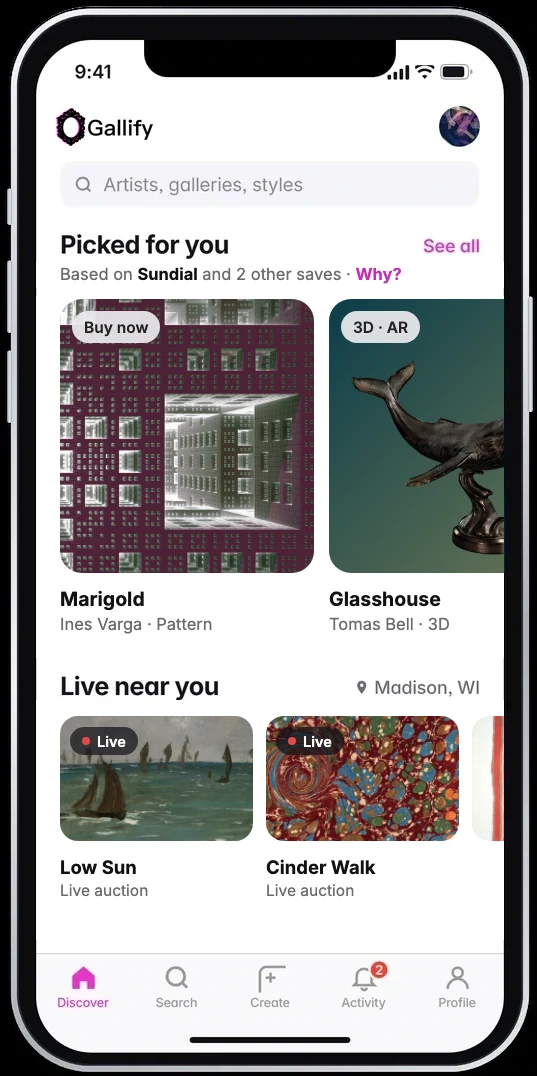
Browse the feed, local auctions and playlists, and tap Why to see what a pick is based on. Every pick comes with a reason.
- 3
See it in AR
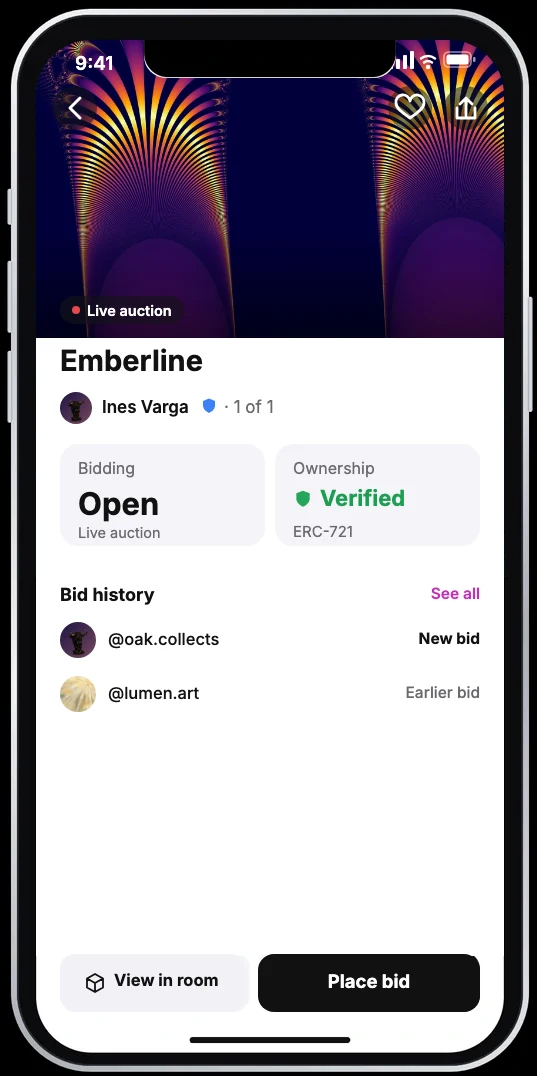
Place the piece on your own wall at its real size, resize it and take a snapshot. People loved the moment.
- 4
Bid
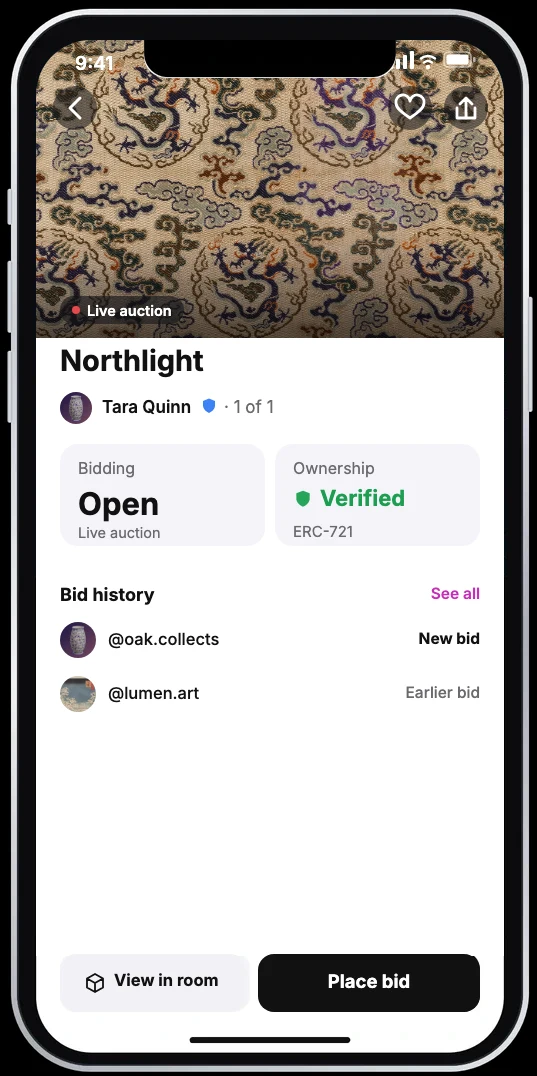
Connect a wallet before the first bid, then approve each bid in your own wallet. Gallify never holds anyone's keys.
- 5
Keep watching
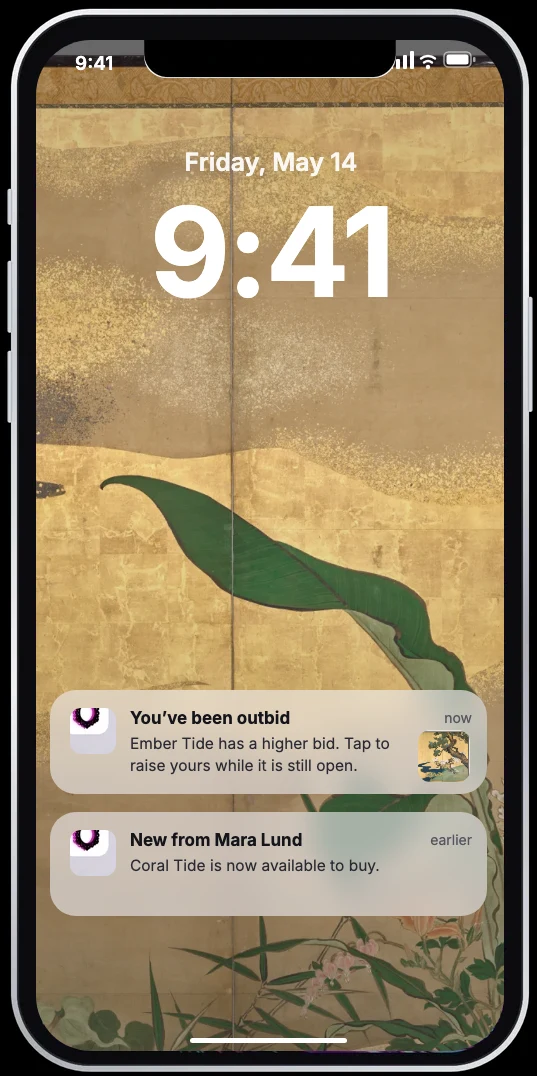
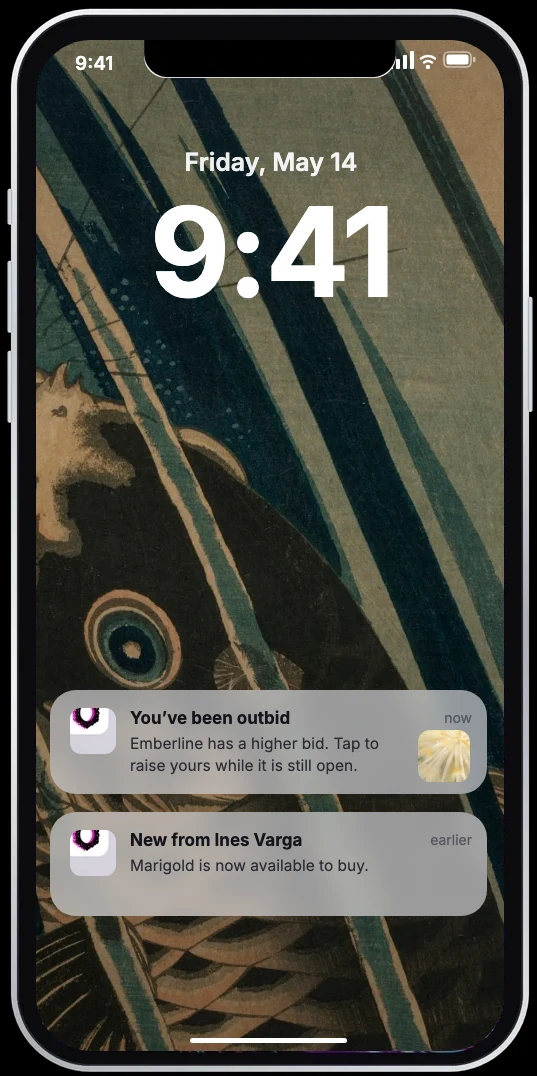
An outbid alert tells you while the auction is still running, and a purchase is a one-of-one token you can verify. On-chain ownership is what proves the piece is yours.
An artist's journey
- 1
Set up
Start a gallery from a phone. It takes minutes. Each artist gets a gallery and a link to share it.
- 2
Add work
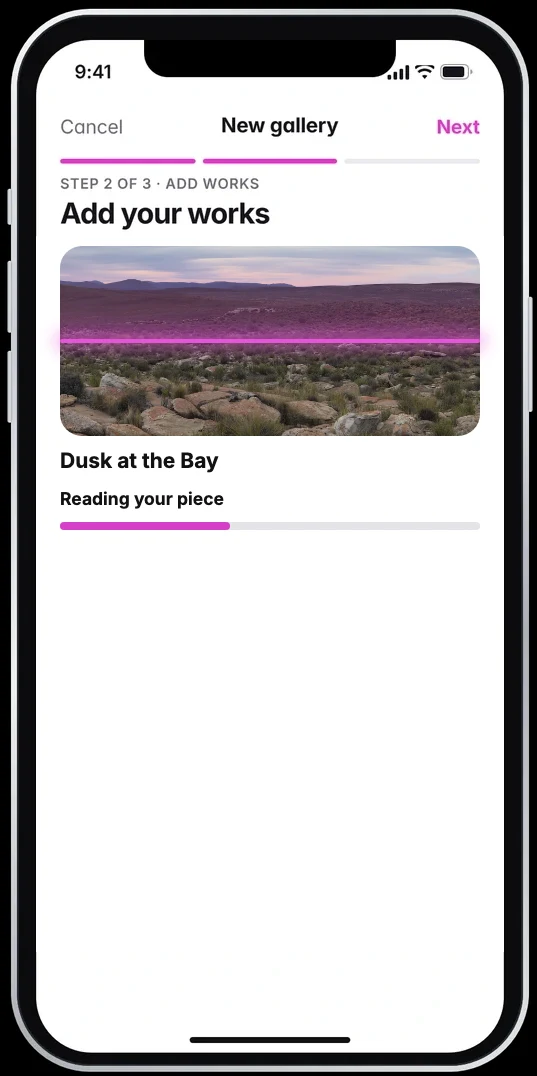
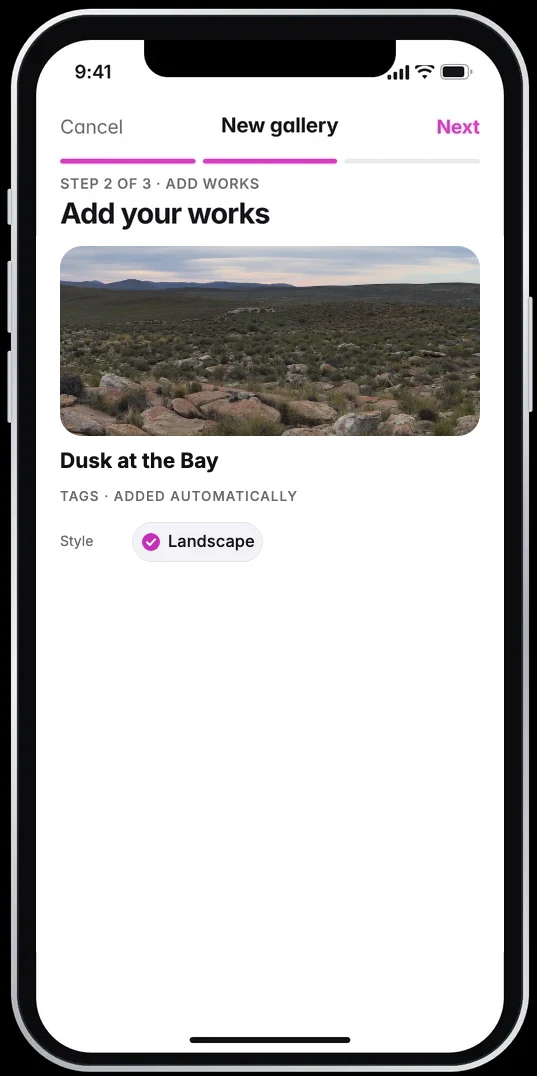
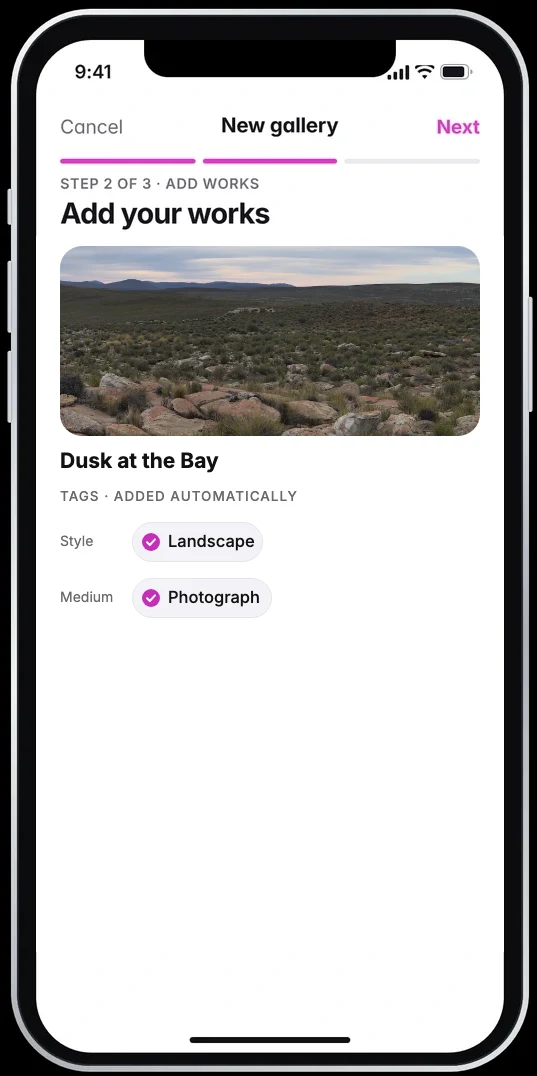
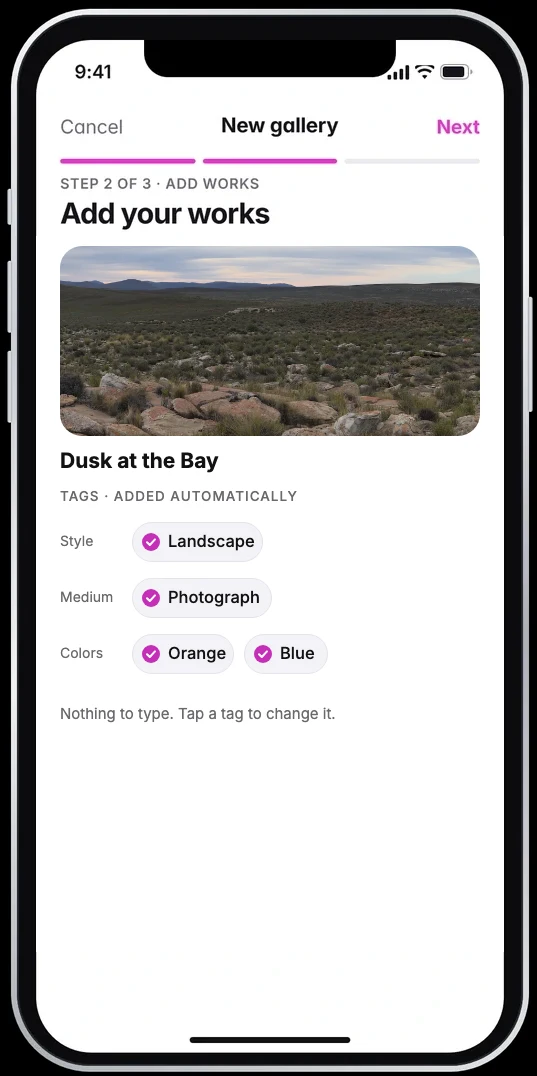
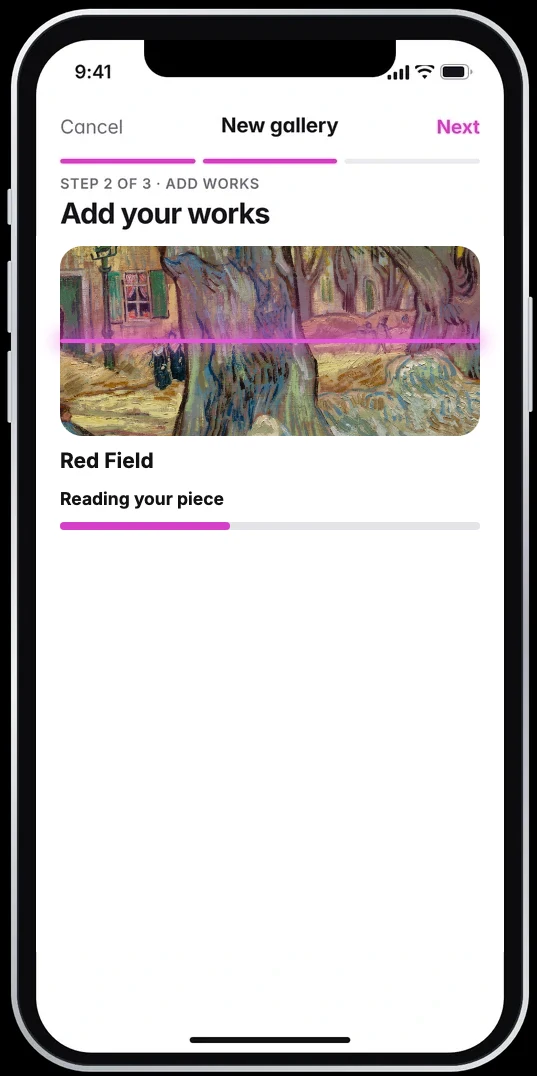
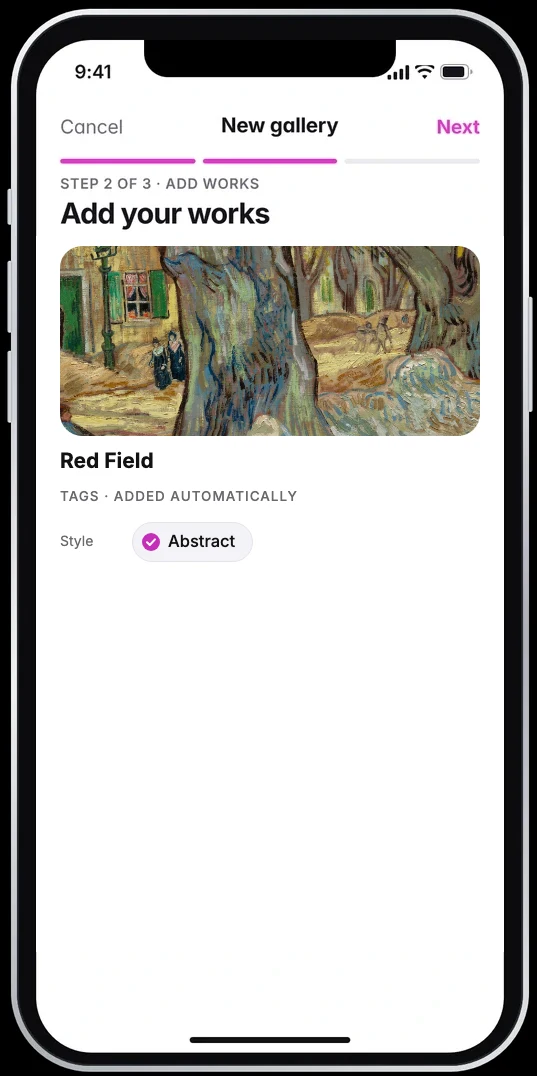
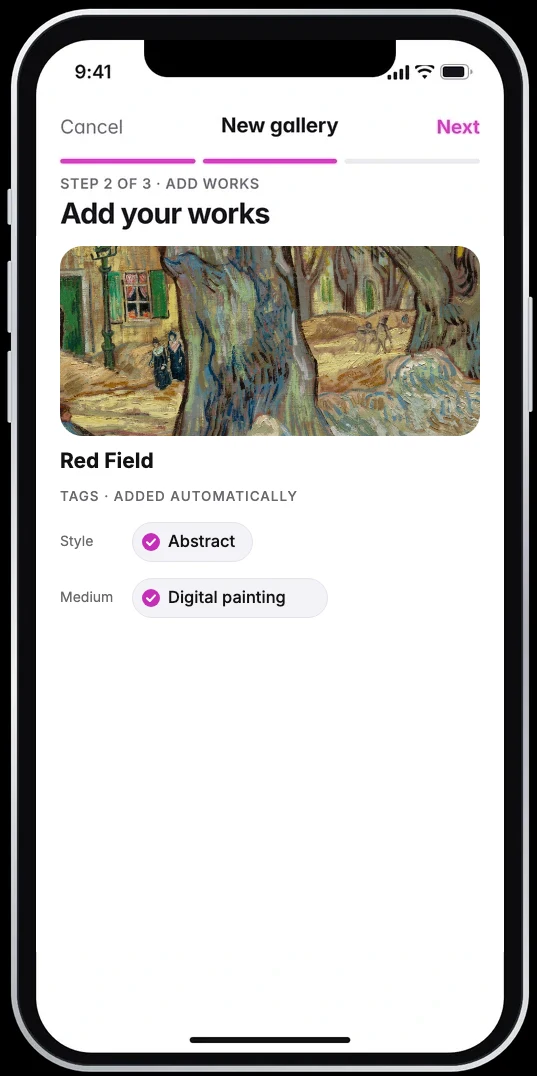
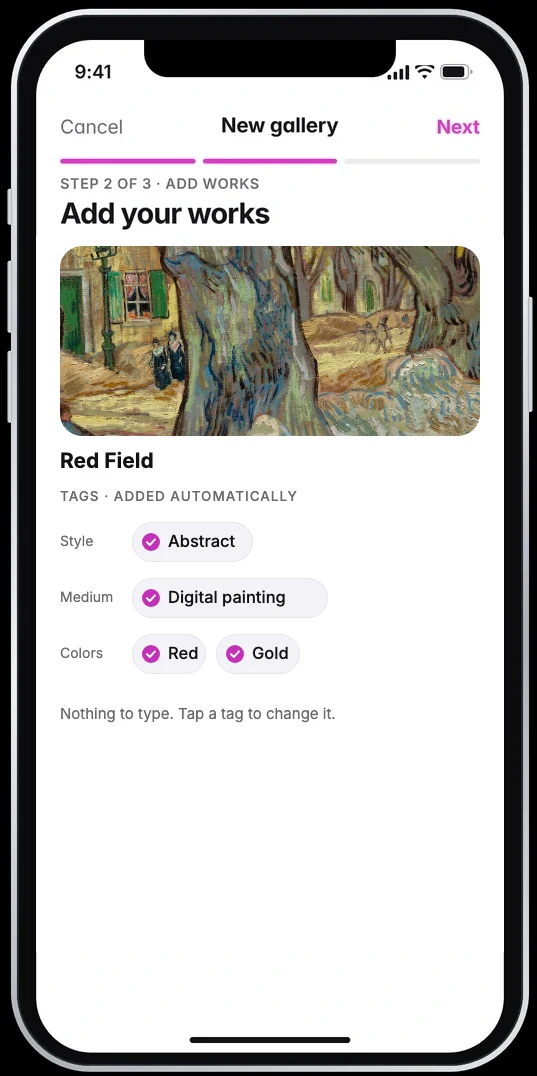
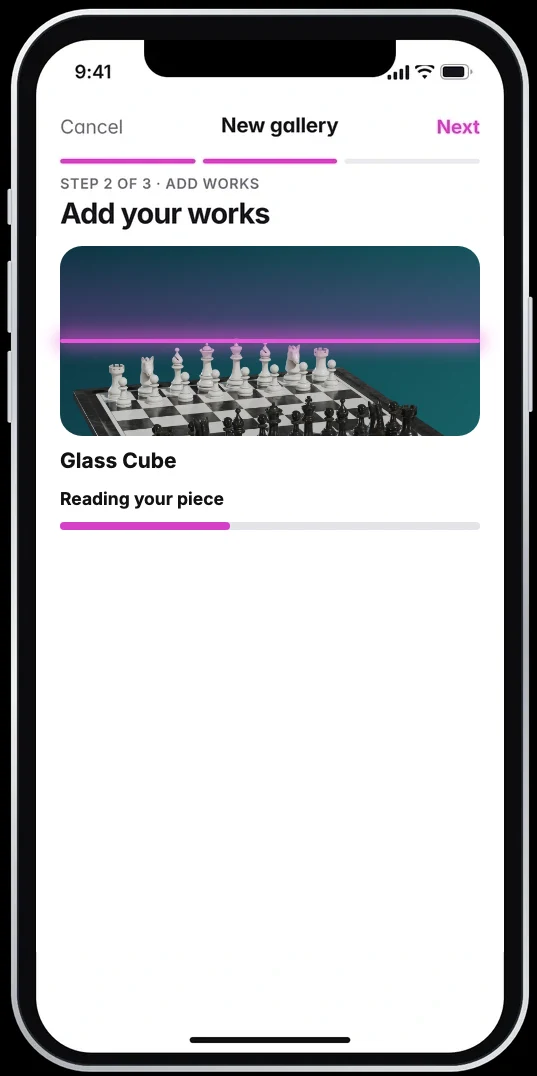
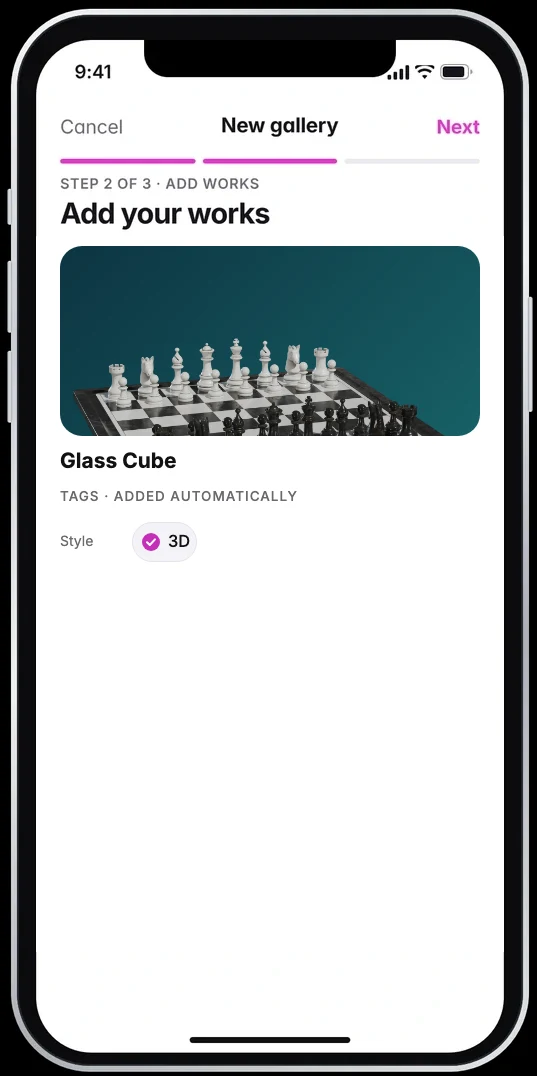
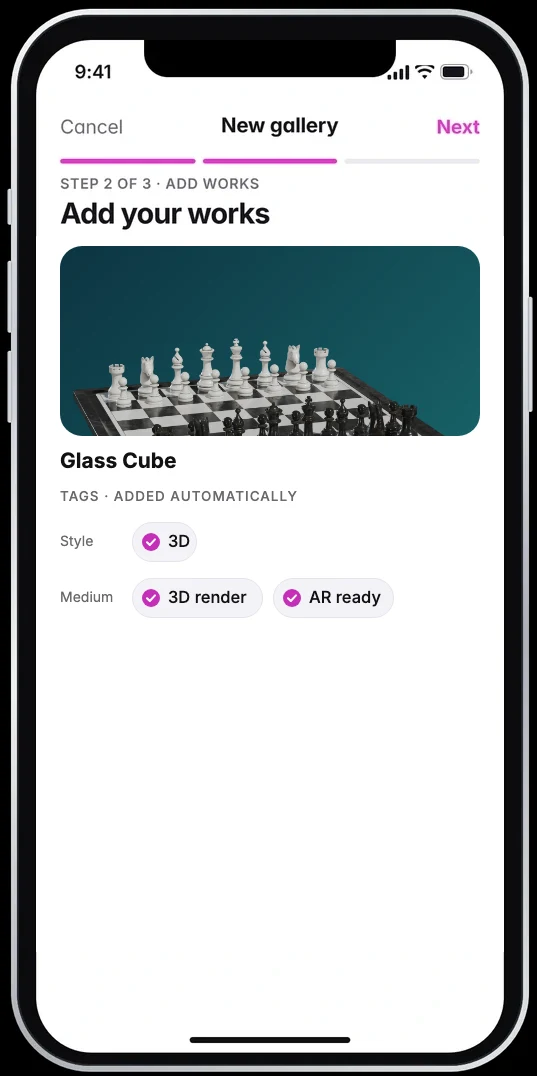
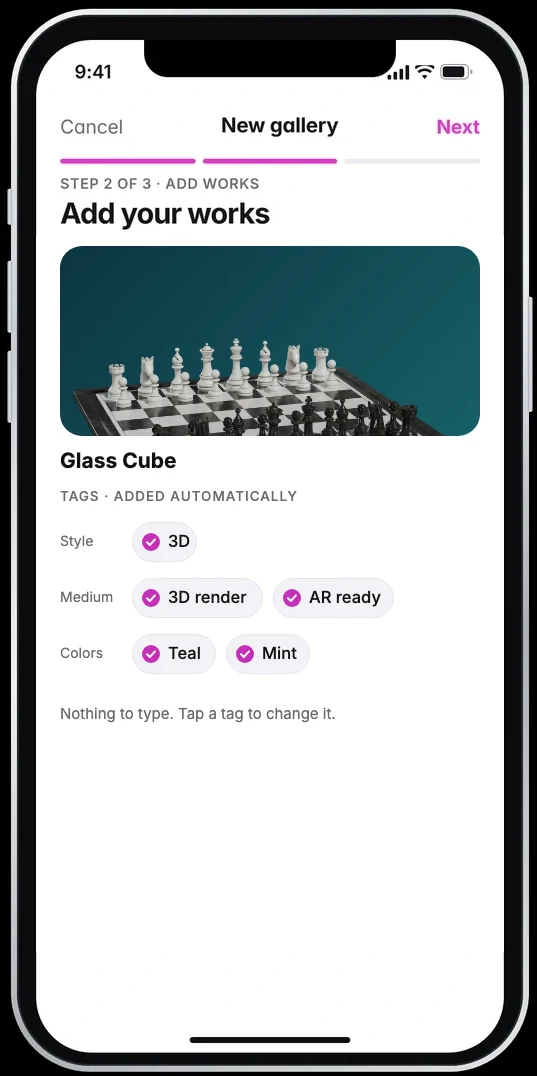
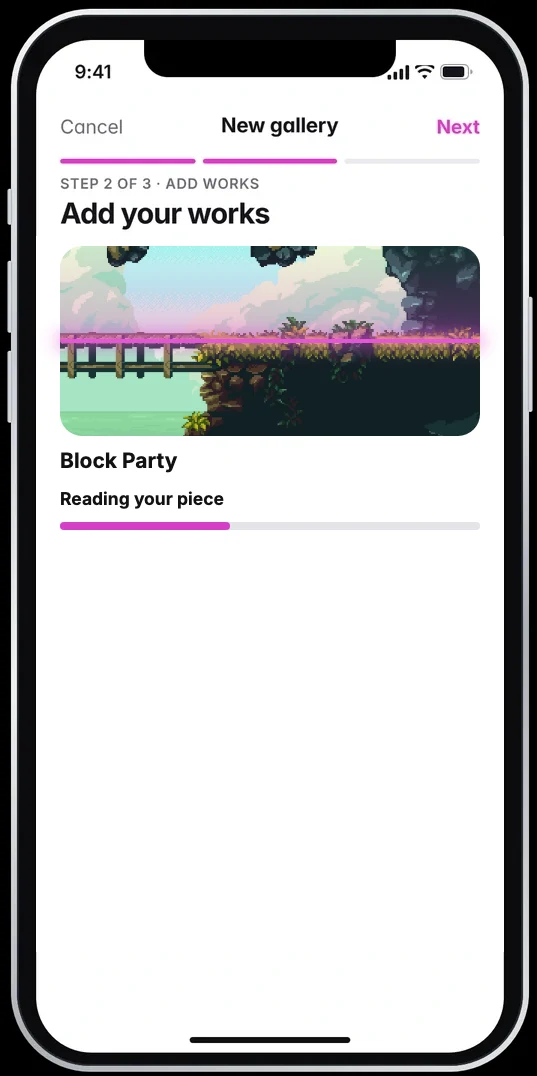
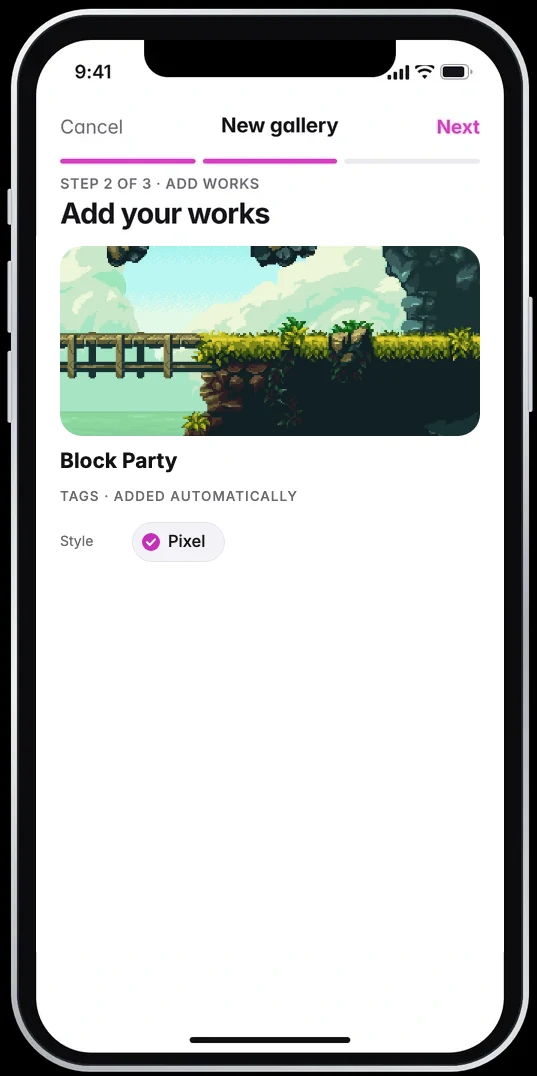
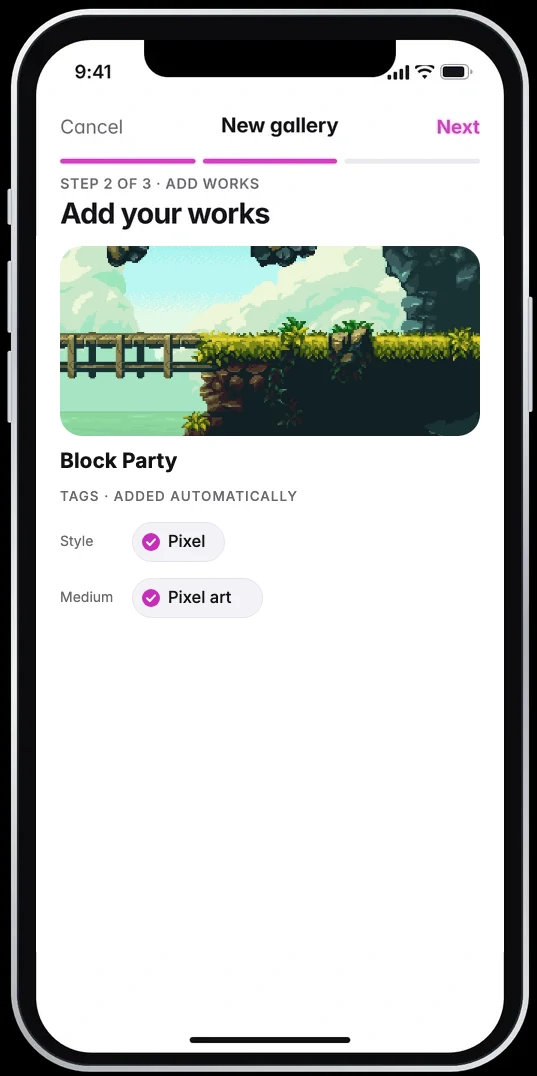
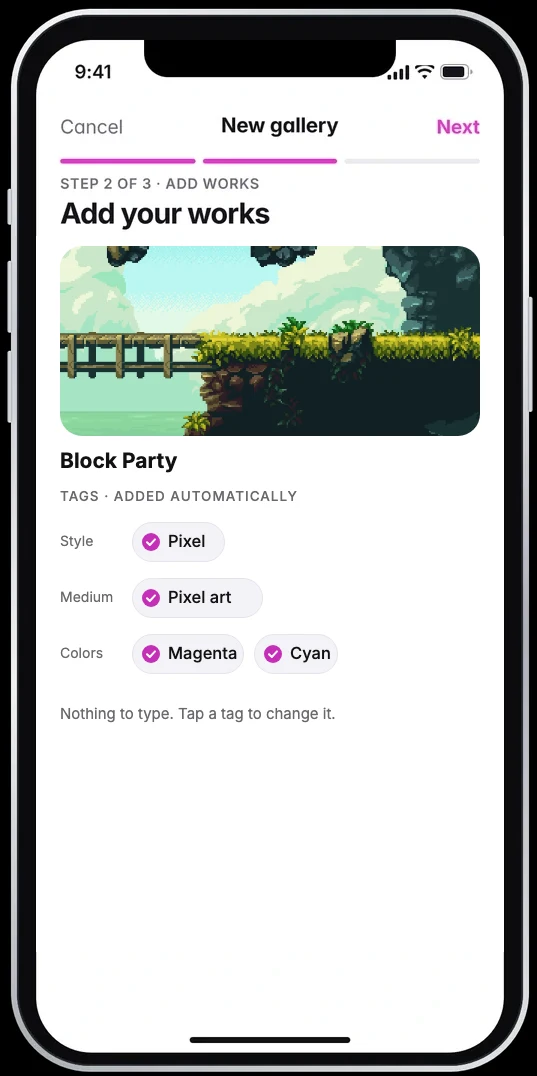
Upload images, or capture a physical piece in 3D, and let auto-tagging tag it. Artists no longer have to tag every piece by hand. Auto-tagging cut the time to list a piece by 60%.
- 3
Mint
Mint each work as one-of-one. A purchase then means verifiable ownership. Each work is a one-of-one token on Polygon, an ERC-721 contract written in Solidity.
- 4
Create and share
Publish the gallery and share one link, in minutes. It is the promise on the beta page. Artists published galleries because they wanted to be seen.
How the pieces fit together
- 1
iOS app
Auctions, discovery, galleries and profiles, built in Swift for iPhone. The home screen is a feed built for each collector, with local auctions, playlists and a featured room.
- 2
AR layer
ARKit places any piece on a wall at real size; Object Capture turns physical work into 3D. Collectors can resize the piece and take a snapshot before they bid.
- 3
Ownership
Solidity smart contracts on Polygon issue each piece as a one-of-one token. It is an ERC-721 contract, and Polygon's low fees suited small first purchases.
- 4
Wallet
The collector approves every bid and purchase in their own wallet. Gallify never holds anyone's keys, which meant fewer security obligations for us and more trust for them.
The recommender
I led the AI recommender for listings. Collectors arrived without a clear idea of what they wanted, and every artist wanted to be seen, so a feed that put the right piece in front of the right person was the most valuable thing we could build.
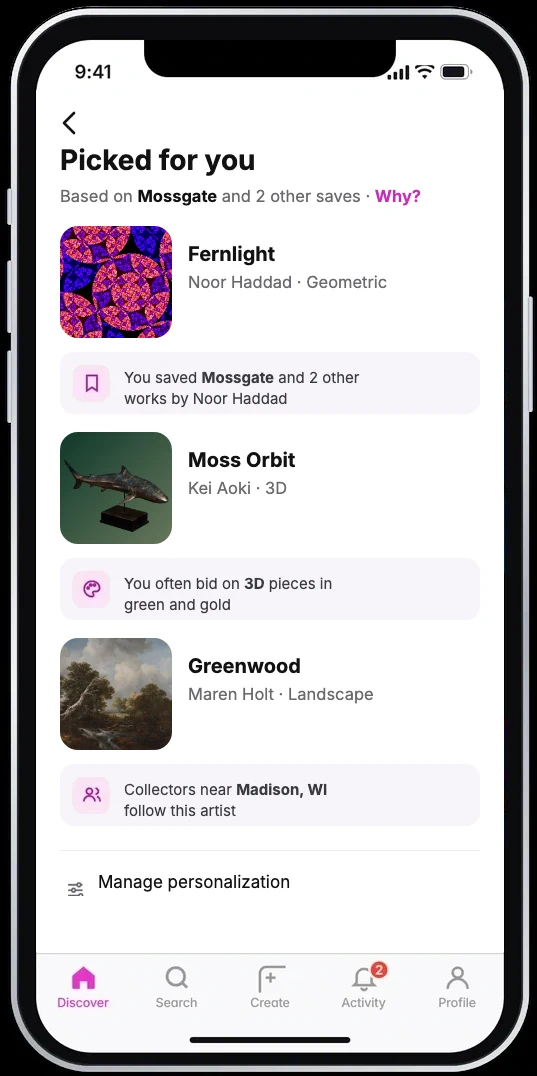
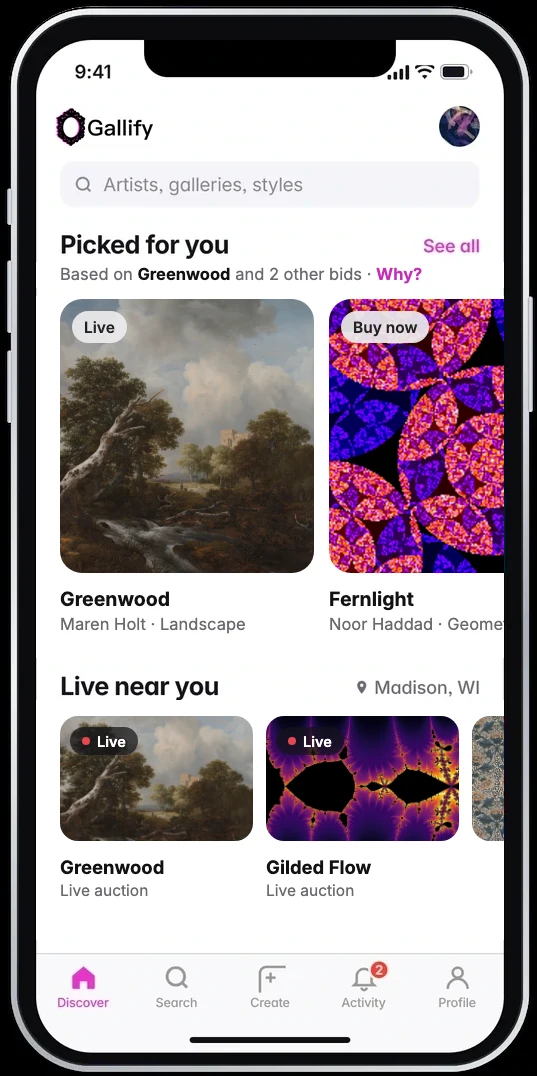
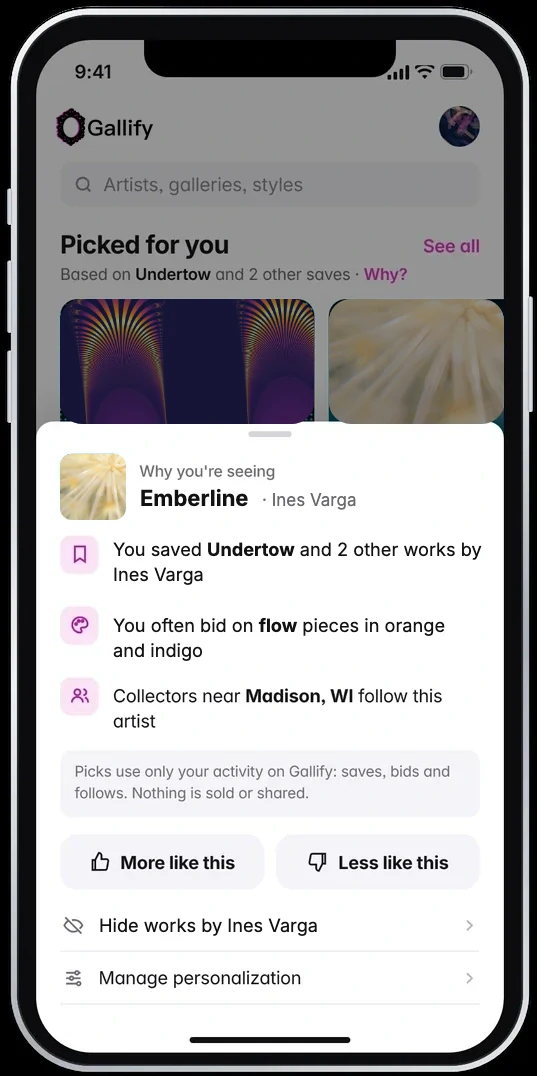
It ranked live auctions and listings for each collector from their browsing behavior (what they had viewed, saved, bid on and bought) and from how visually similar pieces were, plus each piece’s style, medium and artist. New collectors picked a few styles they liked first so the feed wasn’t empty on day one. Each pick had a reason behind it, and collectors could ask for more or less of something, or hide an artist. We measured the feed against our previous ordering, looking at click-through and at average order value rather than time in the app. Click-through rose 30% and average order value 20%.
How the recommender worked
Signals come from what a collector does (what they view, save, bid on and buy), from how visually similar pieces are, and from each piece’s style, medium and artist. New collectors pick a few styles first, so the feed is never empty on day one.
The ranker scores live auctions and listings for each collector and reorders them as they browse. Every pick comes with a reason, such as works you saved or pieces you bid on, and controls to see more, see less, hide that artist or manage personalization. Picks use only a collector’s own activity on Gallify.
Two things fed back into the ranking, namely what collectors did with the controls, and the measured results. We measured against the previous feed on click-through and average order value, which rose 30% and 20%.
Auto-tagging
We also built computer-vision auto-tagging for 2D and AR/VR artwork, so artists no longer had to tag every piece by hand. It cut the time to list a piece by 60% and lifted search conversion by 25%.
Results, what I learned and what is next
Growth
Gallify grew to more than 7,500 users, 2,500+ artists and 5,000+ buyers, at about 15% a month, mostly organically, and we secured investment from a Midwest venture capital firm.
| Delivery measure | Result |
|---|---|
| On-time delivery | From about 60% to 85% |
| Average bug resolution time | About 35% faster |
| Team velocity | About 30% higher, with scope and budget within 10% of projections |
| Time to productivity for new engineers | About 25% shorter |
| Active projects | All 6 delivered on schedule, within 8% of estimates on average; production incidents under 2% of deployments |
Over five years we shipped three major releases. They covered marketplace transactions on the blockchain, the AR gallery experience and the iOS app itself, and we designed, built and launched the platform ahead of schedule. The recommender gave us the 30% and 20% lifts described above.
| Outcome | Result |
|---|---|
| Users | 7,500+ (2,500+ artists and 5,000+ buyers) |
| Growth | About 15% month over month, mostly organic |
| Investment | Secured from a Midwest venture capital firm |
| Click-through from recommendations | +30% |
| Average order value | +20% |
| Time to list a pieceAuto-tagging | −60% |
| Search conversionAuto-tagging | +25% |
| Major releases | 3+ (marketplace transactions, AR galleries, iOS) |
| Platform | Designed, built and launched ahead of schedule |
| Business | Broadened from digital art to public art in 2021, with CODAworx |
Moving to public art
The product worked. People used the AR view, the recommendations measurably moved sales, and the user base kept growing. In 2021 we decided to broaden from digital art to public art, which became a new venture with CODAworx called CODAmarket. I recommended the move.
I wrote the recommendation as a short product decision, so the team could see how I got there.
Decision memo
- Decision. Whether to keep building Gallify on digital art or to broaden to public art.
- Options. Keep going on the same bet. Broaden to public art with CODAworx, which became CODAmarket.
- What I looked at. Whether the people who tried Gallify came back, whether new collectors kept arriving without us pushing, and whether the team was still excited about it.
- Recommendation. Broaden from digital art to public art and put our effort there, where our CODAworx partnership had opened a larger market.
- Afterwards. I told the team directly, did what I could for the people who had put years into it, and made the app’s code public so the work stays visible.
What I learned
- A bet needs a stated assumption and a measure before engineering starts. The two we could measure, the feed and auto-tagging, gave us clear answers. The two we could not, AR and on-chain ownership, left us guessing.
What I would do differently
- We built AR and blockchain ownership before we had proof that enough collectors wanted them. Today I’d test demand first with something much cheaper, like a landing page, a handful of artists and a manual version of the experience.
- Our delivery numbers improved a lot. I now decide up front which retention number I will track, and I look at it every month.
- Moving to the bigger market was the right decision. I would make it sooner.
- Telling users why a piece is shown, and letting them change it, was cheap to build and gave us a clearer signal than clicks alone. I’d do it from the start on any recommender.
What is next
The move to public art became CODAmarket with CODAworx. The lessons above are the rules I carry into the next product. Test demand with something cheap first, set the retention number to track before building, explain every pick to the person it is shown to, and decide as soon as the numbers are clear.
Test demand with something cheap first
Set the retention number to track before building
Explain every pick to the person it is shown to
Decide as soon as the numbers are clear
Reports
Each note below says what it covers and what it does not.
- How it was measured. The numbers behind the growth, the recommender and auto-tagging.
- The move to public art. What I looked at and what I recommended.
- Assumptions and what was tested. Which bets were checked and which were not.
How it was measured
The growth figures are users (2,500+ artists and 5,000+ buyers), about 15% month over month, and mostly organic. The recommender lifted click-through 30% and average order value 20%, and auto-tagging cut the time to list a piece by 60% and lifted search conversion 25%. The results tables above list each one. It covers what the team measured at the time. It does not include revenue.
The move to public art
The product worked, and in 2021 I recommended that we broaden from digital art to public art, which became CODAmarket. I looked at whether people came back, whether new collectors kept arriving without us pushing, and whether the team was still excited. It covers my recommendation, not the whole market.
Assumptions and what was tested
The feed and auto-tagging were measured against the previous feed and against listing time. It covers those measures, and it does not claim more for AR or ownership than the page already says.